Saturday, October 27, 2018

Putting Latin in the Ears of your Students

Over the past few weeks, I have had some great conversations with Latin teachers both in person and online regarding using spoken Latin in their classrooms. These teachers considered themselves to be traditional teachers who had never experienced active Latin before or never had Latin come out of their mouths for the purpose of communication. For these teachers, to even consider using spoken Latin with their students was a scary experience and was something which they had opposed for years. Somehow, though, they decided to start reading sentences aloud from their textbooks to students and asking students comprehension questions in Latin about what they had just said. These teachers reactions? Wow, their students were able to respond in Latin and enjoyed it! As a result, these teachers have come to the conclusion that it is important to bring in some degree of active Latin to their classrooms, even if they are not experienced in speaking Latin, because having students hear Latin really helps in the acquisition process.

I can completely relate to this, because for the first twelve years of my teaching career I was vehemently opposed to the use of any type of active Latin. My primary defense was "What is the point in speaking Latin if our goal is for our students to read Cicero" (and I hear this defense A LOT). However, my opposition to active Latin was mainly because I had not learned Latin with a spoken element, had never spoken Latin before, and had never experienced Latin as a living language. In other words, my opposition was actually based on my own fears and inabilities, rather than on actual research. However, after attending my first Rusticatio in 2010, I realized that we traditional Latin teachers were leaving out such a HUGE component in the acquisition of Latin by not speaking the language.

But why speak Latin in the classroom? According to Nancy Llewellyn from her article "Why Speak Latin?":
All those of us who teach have known or have taught a few outstanding students who could read extremely well and yet do not speak. But for every one of these, how many others have we lost? How many talented kids have we seen quitting after only a few weeks, or getting bored after a year or two and moving on to something they can internalize and really make their own, such as Arabic, French or Spanish? What we call the traditional method can work tolerably well for the 50% of our class which is composed of visual learners (indeed, extremely well for the top 2% of these), but what about the rest? What about the auditory and kinesthetic learners, whose primary learning modes are so rarely and scantily addressed? 
Let me also say that just speaking Latin in class in and of itself does not lead to language acquisition. If done incorrectly, it can impede student learning and just leave learners frustrated. For spoken Latin to be effective, it needs to be comprehensible. This is achieved by:
  • establishing meaning in L1. Write the Latin word with its definition in English on the board, and point and pause. Do not make the assumption that meaning is obvious through the use of gestures, pictures, etc. Gestures and picture can help create visual cues for learners, but establish meaning in L1 in order to ensure that everyone is on the same page. I can speak from personal experience where Latin speakers have tried to establish meaning of unknown words for me in L2, and all it did was result in frustration for me and not wanting to speak to that person. Just tell me the #%@$ meaning in L1 so that I can move on! I can only imagine what my own students would feel like if I were to do that to them.
  • speaking slowly. Annabelle Allen, whom I absolutely ADORE and RESPECT, says, "If you (as the teacher) are not bored by how slowly you are speaking (to students), then you are not speaking slowly enough." I can tell you that my affective filter SKYROCKETS whenever I hear advanced Latin speakers speaking so fast that their Latin sounds like just one long word to me. Although you may be a fast processor when hearing the language, remember that most learners are not.
  • remembering the level of your listeners. If we are being realistic, we will remember that although we may have Latin 3 students, they are actually only 3-year olds in the language. Do you personally speak to 3-year olds like Cicero?
So if you are new to speaking Latin and are a bit hesitant, here are some ways in which you can put some Latin in the ears of your students:
Let me end with this: you do not have to be a master Latin speaker to use active Latin in your classroom; you just need to be better than your students. Yep, you are probably going to make mistakes, but that is okay. Most likely, your students will not catch the errors, and you can always correct yourself - I correct myself all the time. it is perfectly okay to have a script! If someone tells you that you must speak Latin perfectly (and that includes pronunciation) before you begin to do it in the classroom, then I will tell you that you will NEVER get around to speaking it, because you will never be at that level of perfection. I do not always speak perfect English, and English is my mother tongue!

Years ago, I told Rose Williams, a veteran Latin teacher in Texas, "I need to apologize to that first group of Latin students whom I taught, because I had no clue what I was doing." Her reassuring reply to me was, "But even though you were probably just a few pages ahead of your students in the textbook, they still loved you anyway." To those of you who are hesitant to speak Latin in your classroom because you do not think that you are good enough, let Rose's message be my message to you.

Monday, October 22, 2018

GimKit

After hearing much about this and reading about it on social media, I decided to try out GimKit last week, and wow, I am now a believer! It did not disappoint! GimKit is an online digital assessment tool much like Quizizz, but it has so many different upgrades and power-ups for students to use while they are playing this game. GimKit was created by students for students, so because of this, there is so much in this game which students find engaging.

The basic set up is like Quizizz in that students answer multiple choice questions asynchronously on their devices/computers at their own pace and receive "money" for correct answers, with the goal of having the most "money" at the end of the game. Students can play individually or on teams - if you put students in teams, they will still answer individually instead of collaboratively, but the "money" which they earn goes towards the team total. However, GimKit has some big differences which add to the fun:
  • Upgrades/Powerups - As students/teams gain "money," they can buy upgrades and powerups, such as increasing dollar values for correct answers, increasing question multipliers, insurance for incorrect answers, and removing two incorrect answers from the choices. In addition, however, they can also purchase powerups such as removing 20% from a team's total, reducing another's earnings by 50% for a minute, and increasing a bonus for a single question. 
  • Length of game - Instead of the game ending after all questions have been asked, the length of the game is determined by time or by total class earnings. As a result, questions are on a continuous loop.
  • Leaderboard - Because the leaderboard can be projected onto the screen, teams are always aware of where they stand, hence they know whom to "attack" with powerups.
  • The only way to earn money is to spend it in this game!
Pros:
  • The game is SO enaging for students once they understand how upgrades and powerups work. This is what makes students want to continue playing the game.
  • Because questions are asked asynchronously like Quizizz, students can proceed at their own pace. Where Kahoot is a game of speed where the fast processors benefit, GimKit allows for the slower processors to answer at their own speed but still contribute to the team.
  • Because questions are on a continuous loop, this allows for lots of repetitions.
  • You can easily import questions from an already existing Quizlet Live set or from a CSV form. 
  • You can enter in student names ahead of time to prevent "naught nicknames".
  • Like Kahoot and Quizizz, you can share your "kits" with other teachers and can assign it to students.
Cons
  • Like Quizizz, the only feedback which students receive for incorrect answers is the correct answer itself. Unlike Kahoot which is synchronous in nature where the teacher can review reasons for incorrect answers communally with the class before moving on to the next question, students do not receive any feedback as to why they answered incorrectly in GimKit.
  • Because the game length is based on time or the class combined-totals,and because the questions are on a continuous loop, if you do not have enough questions, it can get boring for students. I have found that 75-100 questions for 10 minutes is a good amount.
  • Pricing - There is a free version which you can use, but one can only create 5 kits, with 1 edit per kit. The pay version is $7.99 for a monthly pay-as-you-go, or one can pay $59.88 for a year. There is a discounted school/district price.
I was surprised at how engaged students were when playing GimKit. Although students were in teams but not sitting by each other, it was fun for me to hear students yell out, "Who just spent $3,000?!!" and "The Blue Team just attacked us - someone buy a Powerup to attack them and a Shield to protect us?" My students have asked to play this game again, but in order to prevent the novelty, I will only play 2-3 times a semester at the most.

Here are some "kits" which I have made on GimKit (you need to be logged in to play) so you can see how it is played - one is a Latin review of 4 Roman festivals, and the other is a pure vocabulary review.

Monday, October 15, 2018

More Brain Breaks - True/False, Heads/Tails, & Life or Death

Here are some more quick, fun brain breaks which can be done in the target language.

1. True/False
  1. Have students stand up.
  2. Explain to students that you are going to read a statement. 
  3. If students think that the statement is true, they are put their hands on their heads.
  4. If students think that the statement is false, they are to stretch their hands to their sides (like a T).
  5. Reveal if the statement is true or false.
  6. If students get the answer incorrect, they are to sit down.
  7. Do another true/false statement, repeating steps 3-6.
  8. See who is left standing, and do a 3rd statement if desired.
Some statements:
  • There are more trees on earth than in the Milky Way (TRUE - there are 3.04 trillion trees
vs. 400 billion stars)
  • It takes seven years for your body to digest gum (FALSE - it is digested like normal food)
  • Mickey Mouse’s full name is Michael Theodore Mouse (TRUE)
  • The most popular sold item at Walmart is shampoo (FALSE - it is bananas)
  • Dogs are banned on Antarctica (TRUE)
  • Mickey Mouse was originally supposed to be a rabbit (TRUE)
  • Sunsets on Mars are blue (TRUE)
  • In Alaska, it is illegal to shove a moose into a movie theater (FALSE)
  • You can actually charge your smartphone using static electricity from your hair (FALSE)
  • No two tongue prints are the same (TRUE)
  • Hello Kitty’s real name is Tammy Sue (FALSE)
2. Heads/Tails
  1. Have students stand up
  2. Take out a coin, and tell students that they need to predict if the coin will land heads or tails. 
  3. If they think that it will be heads, they will put their hands on their heads. 
  4. If students think that they it will be tails, they will put their hands on their bottoms.
  5. Flip a coin.
  6. Depending on the coin toss, whatever students who incorrectly predicted will sit down.
  7. Repeat again three more times.
3. Life or Death (I got this one from Miriam Patrick, who in turn got this from Andrew Snider)
  1. Make a statement, and ask students if this is a life or death situation.
  2. Continue adding details to the statement, and ask students if this changes the situation to life or death.
Some statements
  1. Rhoda is in the kitchen.
  2. There are lions in the kitchen with Rhoda.
  3. The lions are starving.
  4. The lions are sleeping.
  5. Rhoda runs out of the kitchen.
  6. Rhoda steps on the lions' tails.
  7. The lions do not wake up.
  8. An asteroid then hits Rhoda.
Observations
  1. I like doing these brain breaks in the target language, because it requires students to listen. Depending on the level of your students, it may be necessary to do True/False in English.
  2. I have found that students get very competitive with the True/False and Heads/Tails brain breaks.
  3. An administrator came to observe me when I was doing a True/False brain break, and I made her participate. She was so impressed that she now wants the Special Education teachers to observe our Latin department, because she wants them to start using brain breaks in their lessons.

Wednesday, September 26, 2018

Using Storyboard That to Deliver Input

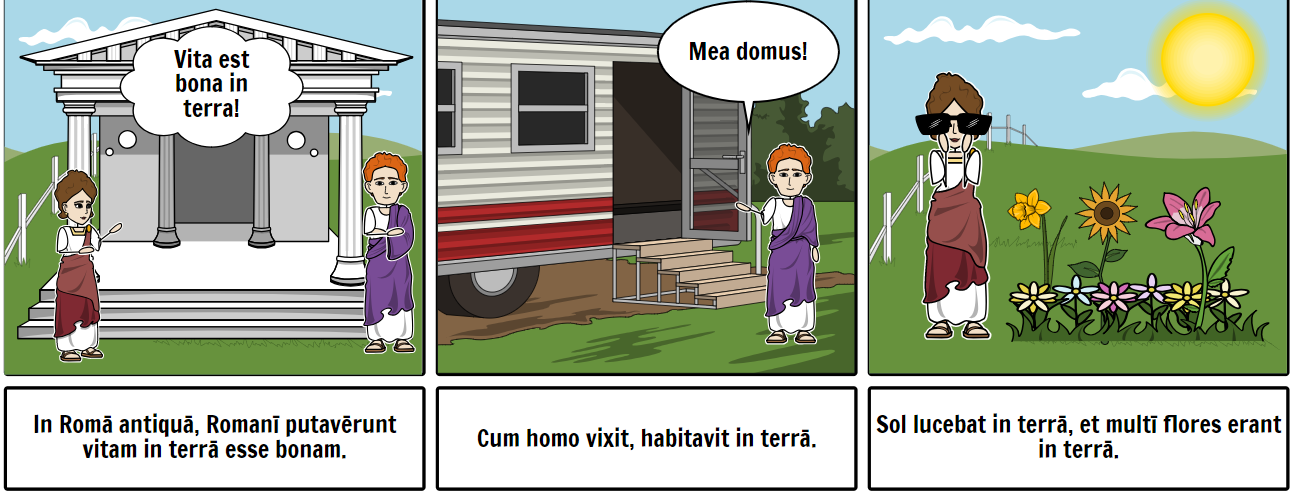
This week, I have been playing around with Storyboard That, a web technology which allows users to create "storyboarded" versions of readings as a form of digital storytelling. This week, I was introducing a unit on the Underworld (which we will be covering for the rest of the semester), so I decided to try out Storyboard That as a post-reading activity. Below is what I created:


Below is a video explaining about how to use Storyboard That:


Observations
  1. This is definitely another novel way to deliver input and to do a reading due to the comic-book nature of the pictures and of the layout.
  2. I downloaded my storyboard as a powerpoint and created a screencast so that students would receive double input from hearing me narrate the story in Latin and from reading the Latin at the same time.
  3. There is definitely a learning curve in discovering how to use Storyboard That, because there are so many illustrations and options which you can use to create content.
  4. I can definitely see having students use this tool to create their own content, but like most technology, they need to learn how to use it properly, i.e. this is an easy tool for students to get caught up in the "bells and whistles" without creating anything with real substance or new meaning.
  5. Using this tool, I would like to create a library of "graphic readers" for students to read maybe during a FVR time.
Unfortunately, there are some drawbacks with Storyboard That. It is a pay-site, and while there are free options available, there are lots of limitations to the free option:
  • One can only create 2 storyboards a week.
  • Storyboards can only be 3 or 6 cells in length.
  • There is limited access to various storyboard layouts.
  • If you wish for students to create a storyboard on their own, they must register for a free individual account on their own OR you can pay per students to create a pay account. However, this may be a student privacy data issue for your school.
There is a free trial account for teachers which will give you extended access, but it only lasts for 14 days.

Tuesday, September 18, 2018

Emoji Picture Story Retell

A few months ago, I wrote a post about using emojis as part of a Find the Sentence activity. Here is an extension activity which you can do with emojis and can be used following doing Find the Sentence

Today in my Latin 2 classes, I used emojis as a story picture retell. Yesterday, I had students do an emoji Find the Sentence with a Movie Talk reading which we had been doing for the past few days. Today, I gave students the story written in emojis (and some English words where there was no fitting emoji) and had them retell the story to each other in Latin in partners. The Movie Talk story itself was incredibly basic with lots of repetitions and limited vocabulary, so it seemed like a perfect story to "emoji-ize" and to experiment as a story picture retell.


Monsterbox
Observations
  1. Because yesterday the class had done a Find the Sentence activity with these same emojis, students were already familiar with what Latin words these emojis represented, because meaning had already been established.
  2. Because vocabulary was limited, it was a very easy story for students to retell relying only on the emojis. If the story had extensive vocabulary, I think that it would have been more difficult due to an overabundance of emojis.
  3. Not every story lends itself to being "emoji-ized" due to not every vocabulary word having a matching emoji. As you can see in my story above, there are no emojis indicating size, so I had to write those words in English, as well as the verb want. 
  4. As an extension, I had students then use the emoji story as a guide for a timed-write so that what they verbally expressed had a place to go.
Overall, using emojis in this way is a novel way to do a story picture retell, and it is definitely one that I will do again in the future. At the same time, however, it does have its drawbacks due to a limited emoji language.

Thursday, September 13, 2018

RRR Days

The Latin program at my school, Parkview High School, has over 700 students taking Latin, and we have had no failures over the past number of years. The fact no student has failed Latin in the past few years has been a distinguishing hallmark of our Latin program and definitely a fact of which my school's administration is very aware. While I do believe that having a CI-based Latin program, embarking on a standards-based grading system, and eschewing the traditional way of assessing students have contributed to this, I will also say that we have a number of students who do not perform well in our Latin classes. To remedy this, however, once a month we have something called an "RRR Day."

RRR Day stands for "Rest, Retake, and Remediation" (or some form of that. I think that each of us in my Latin department calls it something different). The concept, however, is very basic: once a month, classtime is dedicated to students retaking any assessment which they want, making up missed assignments/assessments, and getting needed remediation for material which they are not understanding. If a student does not need any of that, then their reward is a day off in class.  

So how does it work?
  1. On the RRR day (I usually let students know a few days ahead of time), I tell students to check their grades online to see if there are any assessments/assignments which they would like to make up or to retake. If they wish to retake/make up anything, then they let me know. 
  2. If a student has a zero as an assessment score due to absence or has a 70 or below for an assessment, then that student receives a written notification from me, stating that the student has a low grade (or grades). See below:
  3. If a student needs remediation due to a score of 70 or below on an assessment, that student (or students) meets with me during the RRR time for remediation. Many times, I will have a group of students around my desk reviewing a past story with me. I like this individualized remediation, because it shows me what students are understanding, not understanding, where the problems are, etc. 
  4. Once students have demonstrated to me during this remediation time that they now understand the material, then they can do a retake. Usually, I will give them an altered form of the assessment on which they scored lower than a 70.
  5. Those students who do not need to do any remediation, make up, or retakes have the day off. They can work on homework for other classes, listen to music on their phones, play cards, etc. Essentially, an RRR day is a reward for them.
Observations
  1. If your class is proficiency-based and not performance-based, then RRR Days perfectly align with that, because your goal for students is that they demonstrate mastery of a concept/standard no matter how long it takes, as opposed to their performance on an assessment.
  2. Because our program is standards-based, our assessments are quite short (not the traditional 4-5 page tests), so it does not take long for a student to retake an assessment.
  3. Yes, there are students who have received a 95 on an assessment that wish to retake it so that they can get a 100 this time. I do let them retake it.
  4. Because an RRR day is once a month, sometimes much time has passed since the assessment, so students may have forgotten what they did not understand. The remediation time helps correct that.
  5. I personally like the RRR days, because it gives students opportunities to make up missed work, to receive individualized remediation time with me, and to retake assessments to improve their proficiency scores. Both students and I actually get a lot accomplished on these days.
  6. If I were to ask struggling students to come before or after school for remediation, many of them probably would not show up. This way, on an RRR Day, assuming that they are in class that day, these students have no choice but to do remediation with me.
So consider implementing an RRR day in your classroom, and see what a difference it makes for students. 

For further reading, Rachel Ash and Miriam Patrick have a blog post here about RRR days from a few years ago. 

Thursday, September 6, 2018

Story Listening

Today, I ventured into Story Listening with my Latin 2 classes. Story Listening is a pre-reading strategy devised by Beniko Mason, and the title is exactly what it is: students listening to a story being told while the teacher draws pictures as part of the storytelling. No circling takes place, and it is done in the same way as a parent telling children a story, i.e., parents tend not to interrupt a story with questions. I had dabbled before with Story Listening, but I had not added the picture component.

Today, in my Latin 2 classes, I did a Story Listening of the following story - the story of Vulcan and Mars. Below is the story with the pictures which I drew as I narrated the story aloud in Latin.

VULCANUS, PART 1
Iuppiter et Iuno duōs filiōs habebant. Primus filius erat Mars. Mars erat deus bellī. Iuno amabat suum filium Martem, quod Mars erat fortis et pulcher.

Secundus filius erat Vulcanus. Vulcanus erat deus ignis. Iuno non amabat suum secundum filium. Quamquam Vulcanus erat fortis, Iuno non putavit Vulcanum esse pulchrum.

Eheu! Quod Vulcanus erat fortis sed non pulcher, Iuno erat irata. Iuno Vulcanum non amabat, et noluit Vulcanum habitare in Monte Olympō. Iuno Vulcanum ad terram deicit. Vulcanus non iam erat in Monte Olympō sed in terrā. Vulcanus erat vulneratus in terrā.

Vulcanus erat tristis, quod mater Vulcanum non amabat. Vulcanus erat tristis, quod Iuno non putavit Vulcanum esse pulchrum. Vulcanus erat tristis, quod erat vulneratus. Vulcanus noluit habitare in terrā. Vulcanus voluit habitare in Monte Olympō.

TO BE CONTINUED


Observations
  1. Because this was my first real foray into Story Listening, I am glad that I had a very basic story with tons of repetitions and lots of vocabulary with which students were familiar. That made it much easier for me to tell.
  2. This is a very LOW-prep activity for you as the teacher. All that is required for you is the story and a place to draw pictures.
  3. I was surprised at how engaged students were when I told the story. Granted it was a rather comprehensible story to understand when heard aloud, but the fact that I was drawing pictures as I narrated it kept the story compelling.
  4. The pictures added another layer of comprehensible input. Essentially, students were receiving double input: hearing the Latin aloud and seeing the pictorial representation of the story as I drew it.
  5. I suppose one could draw the pictures ahead of time, but drawing the pictures while telling the story aloud forced me to go slow and to repeat a lot by referring to the pictures. I think that students appreciated this.
  6. Because students are just listening to a story and you as the teacher are not asking questions, it can be tricky to see if students are fully comprehending what you are saying. Halfway through the story listening, I did a comprehension check by asking students to tell me in English what was going on in the story. I could have circled or asked comprehension questions in Latin, but since this was the first experience which students had with this story, I wanted to confirm that they understood it.
  7. Because this is a pre-reading strategy (I suppose it could be used as a post-reading strategy), it is important that students are familiar with the vocabulary words in the story either as having already acquired them or as icing words written on the board.
  8. The whole story listening took about 10-15 minutes.
  9. This is definitely something which I going to do more often in the future!
To see how it works, see below for a Story Listening Demo by Beniko Mason


Also, check out this post on the Fluency Matters blog about Story Listening - New or Time-Tested. This is a very good write-up by Carol Gaab.