Showing posts with label writing. Show all posts

Saturday, November 8, 2025

Guided Choice Writing

As I have posted earlier, I am teaching Latin 1 again and am doing things much differently than I have in the past. So much of this is due to my own increased understanding of what is considered realistic language proficiency at this level (Novice Lowish) and that in many ways in the past, my own expectations of student proficiency for Latin 1 were wrong. I have focused on sheltering vocabulary BIG TIME, targeting high frequency words, with the intent of going "deep and simple" and not "shallow and complex."

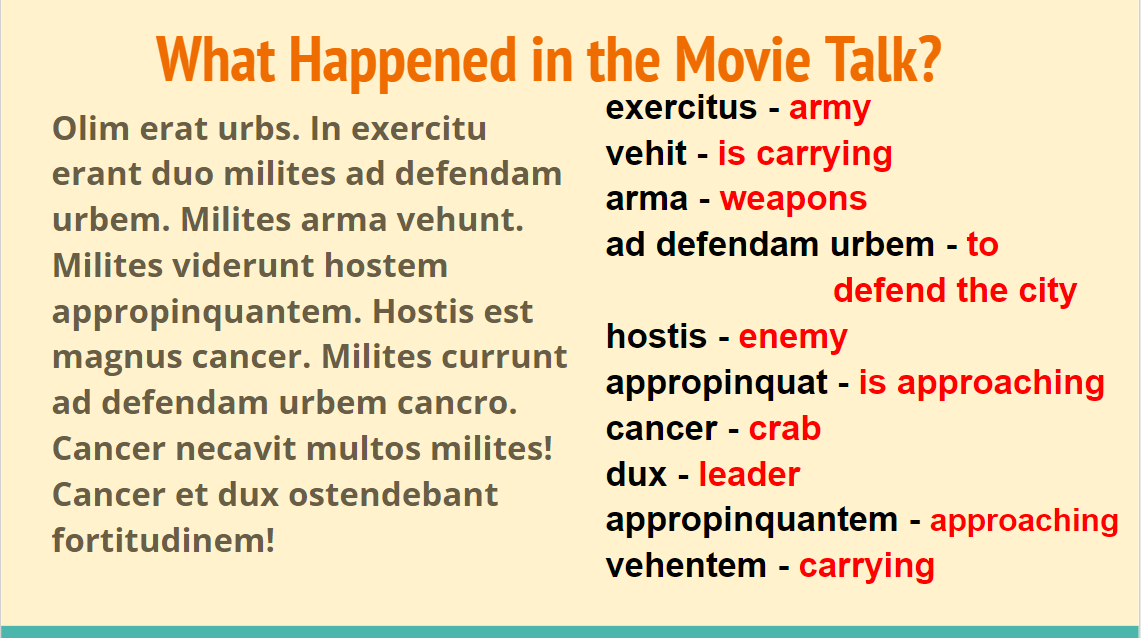
As a result, when it has come to writing, I have been experimenting with students doing "guided writes" instead of doing timed writes. In a "guided write," like the name states, I am guiding students through what I want them to write for the creation of a story, since they are novice low writers. There is a degree of student choice where they can add their own details, but I tell them EXACTLY what they are to write for each sentence based on a word bank. I am also only focusing on words which we have been targeting. Below are some examples from throughout the semester:

Week 6


Week 10

Week 14

Student examples


Observations
  1. If you take a look at the three examples, you can see that I keep adding more details or focus on different aspects as the semester progresses. In the last example, you can see that the focus is on creating guided longer, compound sentences using and and because.
  2. I like the guided aspect, because for these novice-low students, I do not think that they are ready to just "write" without very specific parameters
  3. In many ways, the sentences are like those in Rotating Desks where I am telling students what to write and that they have choice in adding details.
  4. This is a form of purposeful communication on a low level, since students are playing around with the language by choosing their own details to add. 
  5. Will students' grammar be correct? Most likely, no! BUT I also have NO expectations of it to be, since they are novice low learners. I am only interested in "Are they communicating in a way which I as a sympathetic receptor can understand?" I cannot tell you HOW FREEING that perspective is as a teacher!
  6. Even though I am telling students what to write, hopefully as they write these sentences, students are understanding those messages which they are writing. Thus, this is adding to/refining their mental representation of the language. 
  7. This is a precursor to the 4-Word Story writing activity which I will introduce to them next semester. By then, these students should have a foundation where they can write more freely on their own.
Have you done something like this? If not, give it a try, and let me know how it goes!

Sunday, October 5, 2025

Novice Picture Writing Proficiency Assessment w/ Rubric

I am trying out something new with writing in my Latin 1 classes. In previous years when I taught Latin 1, I had students doing timed writes after the first week based on readings/clipchats, but big picture, I never felt comfortable with that, because I felt like all students were doing was spitting back to me memorized sentences from the story, not necessarily any true acquired language. Since they have only had 8.5 weeks of Latin so far this year, they are "babies" when it comes to writing in the target language.

As a result, this year in my Latin 1 classes, I have been holding back on writing in Latin per se (outside of copying sentences from readings in lots of various activities or doing very guided writing. NOTE - these types of writing in the target language still have MUCH value!) so that I am not forcing output too quickly and have chosen instead rather to focusing on bathing them with sheltered vocabulary input before any true output.

After 8.5 weeks of Latin, I gave students their first written proficiency assessment based on a series of pictures which created a story (AI created the pictures). Although students had never seen the pictures before, they did mirror many of the sentences which had been in readings and also in bellringers. The difference, however, was that they had never written this many sentences before in Latin at once in one sitting and never in a sequence for the creation of a story. 

I gave them six pictures, of which there were at least 3-4 sentences which they could write for each of them. HOWEVER, I only asked them for 1-2 sentences for each picture. I debated about this:
  • I knew that there would be some students who could only write one short, choppy sentence per picture.
  • I also knew that there were many students who were already writing compound sentences using "and" or "because," so in writing one compound sentence, they were already demonstrating proficiency beyond the expectation.
  • I was grading this on a rubric, so the minimum number of sentences was not the sole criteria but rather were they also adding details, combining details, etc in the picture?
Below is an example of one of the pictures used (I made two others):

Observations
  1. Wow, I was absolutely amazed at what students wrote and how much they wrote! It was like after bathing them in so much input for the past 8.5 weeks that it overflowed similar to turning on a faucet - it all finally came out!
  2. Student examples from picture 1 (in Latin and English):
    1. Puer Marcus. Puer Julius. (The boy Marcus. The boy Julius).
    2. Puer est Marcus. Marcus est parvus. (The boy is Marcus. Marcus is small).
    3. Marcus est parvus. Julius est magnus (Marcus is small. Julius is big).
    4. Marcus est parvus puer, et Julius est magnus puer. (Marcus is a small boy, and Julius is a big boy).
    5. Hic est puer. Ei nomen est Marcus. Marcus est parvus et laetus puer. Hic est magnus puer. Ei nomen est Julius, et is est laetus. (This is a boy. His name is Marcus. Marcus is a small and happy boy. This is a big boy. His name is Julius, and he is happy).
  3. It was so weird to see the Theory of Ordered Development occurring in their output right before my eyes. A number of students left out the Latin word "is" when trying to write "the boy is big" and instead wrote "the boy big." Before, I would have been frustrated over this and would have blamed the students, but knowing now the Theory of Ordered Development, I was like "Yay, you're proceeding along EXACTLY as you should be!"
  4. Grading on a novice-low writing rubric informed by ACTFL Proficiency Guidelines made it so much easier! Because I was not focusing on errors and performance but rather on "show me what you can do and where you fall on the proficiency continuum/spectrum," this freed me greatly!
  5. Yes, there were spelling and grammar errors - LOTS of them! However, when grammar errors are the norm and expectation since these students are novice learners, I only marked those errors if they impeded my understanding of their messages (even me as the "sympathetic receptor") which lowered their placement on the rubric.
  6. I was surprised by how many students used vocabulary which I had not been truly targeting yet or for which I had not yet held them accountable. However, I had been using these words but usually they were glossed for bellringers, reading passages, and listening. Somehow, these students had already acquired those words, and those words were inside of them ready to come out!
I plan to do more of these kinds of writings!

Friday, September 12, 2025

Rotating Desks

If you have not gotten a copy of Eric Richards’ book “Grafted Writing,” please do so. In it, he details numerous ways to get students writing in a very guided manner - this is great for beginning writers! One of his ideas is called “Rotating Desks.” At the 2023 CI Summit in Savannah where Eric demonstrated numerous strategies from his book, I took part in this activity, and it is a lot of fun!

Directions (his and my adaptation)

  1. Choose a text (or write your own), and use it to create a projectable slide presentation.
  2. Remove an element from each slide, such as vocabulary or grammar, to create “blanks.” 
  3. Label the blanks with the missing element (“noun,” etc.) so the students will know what they are looking for. Students will be adding their own details based on the "blank" description.
  4. After you have created the presentation, you can do the following activity in class. First, have students start with a whiteboard (write their names on their boards) at the top but small OR use a piece of paper.
  5. Then project slide one on the board. Students will write down the entire text from the slide and insert the missing elements/new details. Tell them to write small because there are a number of sentences.
  6. Students rotate to the next desk, but the paper/whiteboard STAYS. Teacher projects slide two. Students read the previous sentence and then add the content of slide two to the paper/whiteboard.
  7. Repeat until slides are done.
  8. Students return to their desks and read them.
  9. MY ADAPTATION - since I am in a trailer this year and am deskless, students used whiteboards, and the whiteboards "rotated" for each slide.

Here is what I recently did with my Latin 1’s:

  1. Puer est in (name of place/ store/ city).
  2. Is est (size) puer.
  3. Ei nomen est (name).
  4. Is (name of female cartoon character/ female singer / female celebrity) videt.
  5. (name from #4) est tristis, et habet (name of object / thing/ food).
  6. Puer (different object / food/ thing) fert.
  7. (name from #4) non puerum amat, sed (name of male cartoon character / male singer / male celebrity).   
Student example (in English):
1) A boy is in Buc-ees.
2) He is a big boy.
3) His name is Oscar.
4) He sees GloRilla.
5) GloRilla is sad and has a CrockPot.
6) The boy brings Takis.
7) GloRilla does not love the boy but Cookie Monster.

Observations
  1. I love this activity on SO MANY levels! I do not know where to begin. This activity definitely has a Mad-Libs feel to it. 
  2. First, I love the guided output aspect of it. Although I am telling students what to write (and those messages are hopefully 100% comprehensible for them!), there still is a degree of choice for them of what details to add.
  3. This is a GREAT example of purposeful communication, because students are playing with the language in adding their own details.
  4. This is a written form of TPRS/Storyasking! Instead of asking students to come up with details orally, they write them down instead.
  5. Because I am asking them to write down known vocabulary and phrases, students are getting repetitions of understandable language in a context which adds to/modifies/enlarges their brain's mental representation of Latin.
  6. When students get a new whiteboard, they must read what has already been written before they can move onto writing the new sentence. What they read should already be 100% comprehensible by this point, because A) the sentence frames are recycling known phrases and words from class but also B) students have already interacted with those sentences by writing them down on the whiteboard.
  7. I loved hearing students laugh when they got back their original whiteboard and read what students had added!

Consider adding this to your toolbox of writing activities!

Wednesday, January 17, 2024

"Grafted Writing" by Eric Richards

I think that one of the most difficult skills for students when it comes to language acquisition is writing in L2, especially if these students already struggle with writing in their own L1. So often we tell our students to "write," and then we are not pleased with the results. In my opinion, there are a number of reasons:

  • we have not properly prepared students for the task which involves writing.
  • we ourselves are not managing our own expectations properly for what students are able to accomplish at their specific proficiency level (level of output, grammatical accuracy, topics, etc.).
  • the task is either too broad with little parameters or too narrow in scope.
  • we have not properly scaffolded lessons nor properly built up students' foundations towards writing.
Well, look no further - let me highly recommend Eric Richards' book Grafted Writing! I had not formally met Eric until last summer at the CI Summit (although I knew of his name professionally) where both of us were coaches/team members in the same cohort. At the end of the conference, he did a short workshop on getting students to write in the target language based on this book, and for me, this was the best part of the CI Summit.

One of the things which I like about this book is how sensible so many of Eric's activities are - namely that many writing activities focus on implementing readings which you as a teacher are already doing with your classes. I like how this allows me to have students do some type of writing 1-2 times a week based on our current reading in different ways and with different goals. As a result, every writing activity does not have to be a free/timed write. And yet many of his "free write" activities are scaffolded in such a way that you as a teacher are not just throwing students into a "sink or swim" writing situation.

Eric's book is firmly grounded in CI/ADI pedagogy, namely that students cannot output without sufficient comprehensible input and that output is the result/overflow of bathing students with understandable messages. While some may view a few of his writing activities as students simply copying down text and calling that "writing," that still falls in line with Comprehensible Input theory. Although "copying" itself is found on the lowest end of Bloom's taxonomy, if the messages which students are copying down are 100% understandable to them, then students are receiving repetitions of those messages through both re-reading those messages and then understanding them as they copy them down - double input, if not triple! Thus, subconscious language acquisition is occurring! And even within those activities, there is a degree of higher order thinking happening within students based on the task!

Each of Eric's activities in this book are broken down into the following sections:
  1. directions/explanation of activity
  2. sample text in English with which to work
  3. suggestions for extension activities
  4. tips and variations
  5. teacher talk
If you have ever met Eric or have attended one of his presentations, you know how practical his communication style is - this definitely carries over into his writing. This book is very easy to read, his directions are not difficult to understand and to picture, and his reflections are very incisive. I have already written about his activity Treasure Hunt - Writing on this blog.

So I highly recommend Grafted Writing as a resource for your CI/ADI classroom, and if Eric is ever presenting at a conference which you are attending, attend his session - you will learn so much!

Wednesday, January 10, 2024

Character "Has/Wants/Is/Does not Want/..." Warm Up

Here is a warmup, post-reading writing activity which you can do with your students if you are dealing with a reading/novella for which there are a number of characters and descriptions. I got this idea from Kelly Gallagher's book Readicide: How Schools are Killing Reading and What You Can Do About It - although the book was published in 2009, there are still a lot of issues which are still pertinent over a decade later.

Essentially, you create a chart in the target language with characters and verbs (I stick with high frequency words), and you ask students to fill out the chart with information which they know to be true about that character. 

Example (in English):

Observations

  1. Since this is a warmup, I like that it does not require students to write in complete sentences in the target language (unless they want to), so it allows them to respond in words/phrases to finish the sentence.
  2. I also like that this warm up does involve higher order thinking, because students are having to distinguish characteristics and actions which are specific to certain characters or to show commonalities between characters. 
  3. It is a great quick way to focus on character development and motivation of characters.
  4. This is also a great graphic organizer for students!

Saturday, August 19, 2023

Treasure Hunt - Writing

 At this summer's CI Summit in Savannah, I attended Eric Richards' presentation "Writing Strategies for the ADI Classroom" (based on his book, Grafted Writing - get this book!!) - for me, easily this was the BEST presentation which I attended that week (tied with Annabelle Williamson's "Brain Breaks," because 1) it was all about brain breaks and 2) it was freakin' Annabelle Williamson!). Eric presented SO MANY really practical ways to get students to write in the target language which are very easy to incorporate into one's curriculum.

One of the activities from Eric's presentation which I recently used with a few of my classes was Treasure Hunt Writing, and it is exactly that: a "treasure hunt" for students to find and copy down specific sentences from a reading based on a number of categories.

Directions

  1. Using a known passage, create your categories. The categories can be structures, certain vocabulary words, or details. Pick categories for which students can find more than one sentence, i.e., do not pick an esoteric category for which there is only one sentence. 
  2. If you want to give students additional parameters, tell students that they need to find X number of sentences for a category.
  3. Give students a copy of the reading, as well as a whiteboard and marker (everything is made better with whiteboards, just like bacon!)
  4. Project a category, and give students time to copy down the sentences based on the category.
  5. As a group, review the sentences which students found.
  6. Have students erase their whiteboards, and project a new category. 
  7. Repeat again.
  8. Variation - you can divide students into groups, and project all categories at once. Each group is in charge of finding sentences for that category. Students can then share and compare their sentences within their groups.
Below is an example which I used - mine was in Latin, but it is in English for you (this passage is actually based on a PQA which Eric demonstrated with our cohort group)

Cooper is not happy, because Kevin is a better basketball player than Cooper. Cooper wants to be a better basketball player than Kevin, but Kevin is the best. Kevin plays basketball very well! Cooper is athletic, but Kevin is more athletic than Cooper. When people see Kevin playing basketball, they shout, "Kevin is the best!" and they celebrate! When people see Cooper playing basketball, they do not shout and they do not celebrate.

Cooper has an elephant. The elephant is big and athletic. The elephant does not play basketball but plays soccer. When people see the elephant playing soccer, they shout, "The elephant is the best!" and they celebrate! Cooper does not want the elephant to play soccer. Cooper wants the elephant to play basketball. Cooper wants the people to shout, "The elephant is the best basketball player!"

Cooper wants the elephant to be a better basketball player than Kevin. Cooper wants the elephant to be more athletic than Kevin. Cooper trains the elephant to play basketball. Cooper trains the elephant to be a better basketball player than Kevin! But the elephant is not happy - it does not want to play basketball! The elephant wants to play soccer!

Categories
  1. Copy down FOUR sentences from the story which contain the Latin word “want”
  2. Copy down THREE sentences from the story which describe Kevin as a basketball player.
  3. Copy down THREE sentences from the story which describe actual or possible crowd reaction.
Observations
  1. This is a great post-reading activity!!
  2. Students need to have some degree of familiarity with the passage, because this involves close reading. This is not at all something which I would do after introducing a passage unless it was very readable and 100% comprehensible for students.
  3. Some may be wondering, "Where is the CI aspect of this? Aren't students just copying down sentences from the reading?" My response: "There is SO MUCH CI going on here!" First off, students are receiving understandable messages in reading/re-reading this familiar passage - lots of robust exposure to familiar language. Secondly, in copying down the sentences, students are receiving more comprehensible input, because they should be understanding the meaning in L1 as they copy down each word; if they are not, then to them they are just writing down "nonsense words."
  4. I love that this is very low-prep activity! All that I had to do was to create 3-4 "categories" for students to find sentences based on the reading.
  5. This is also a great higher-order thinking activity, because for those categories asking for a specific detail, students have to truly read the passage and to use their judgment to determine if a sentence fits that category.
  6. I was surprised at how engaged students actually were in this!
Give this one a try - it is a definite keeper! Thanks, Eric!!

Monday, August 22, 2022

Write and Discuss - the OG version!

This summer I attended IFLT (the first in-person IFLT since 2019), and I did not realize just how much I needed IFLT to "refill my cup"- I came away with a renewed spirit for the school year and so many new activities (specifically communicative-based) which I cannot wait to try out in my classes. I have already blogged about "communicatifying" existing activities, and now I want to add Write and Discuss - the OG version.

I attended a session called "Write and Discuss with Sprinkles" given by Caitlin McKinney, who addressed how to do a basic Write and Discuss and then gave many variations of it. In the session, we actually took part in the basic Write and Discuss and other variations in English as if we were students. Although I had already blogged about my experience with Write and Discuss, I did not have much knowledge or experience with the original way to do a Write and Discuss, and I learned that there are SO many different ways to do one (hence, the "sprinkles" which Caitlyn presented also). Therefore, I will call this blog post "Write and Discuss - the OG version" and call my previous blog post about the activity "Write and Discuss as PreWriting".

A Write and Discuss (OG version) is another way to review a reading/story, and it is done quite early in the scaffolding process of a reading. Following a story introduction (such as a movie talk, picture talk, TPRS story, etc), ask students to tell you corporately what happened in the story in the target language for the purpose of creating a class recap. You can ask students processing questions to guide students and to garner responses. As students give you responses, you will type out the sentence out on a projected document for the class so that they can see what you are writing (Caitlin used a Google Slide for this, and that works great, but I can also see using Google Docs or some type of document). As students recap what happened in the story and continue to contribute, you can also give students the option to add sentences of events or descriptions which happened prior in the story (filling in the gaps) or they can continue moving forward with the story. When you are finished, now you have a class-created document of the story which you can then review the next day with students as a warm up.

Last week, my colleague John Foulk and I did a Write and Discuss (OG version) for the first time. We did this activity with our Latin 3 classes immediately following a Movie Talk (Sand Castle) but because it was an upper level class, we added a new element. The movie talk itself took about 30 minutes, so immediately afterwards we projected the vocabulary from the movie talk and told students that they had five minutes to write in Latin what they could about the movie talk (which hopefully was fresh in their minds since we had just completed it). We then collected their writings and read over what they had written to get an idea of what students were communicating. Then the next day, we returned their writings and showed the movie short again (to rejog memories and for those students who were absent the day before). Following that, using a projected Google Slide, we began the Write and Discuss:

We then asked students or called upon student volunteers one at a time to give us a single sentence in order to construct what happened in the story based on what they had written the day before. The first student had it the easiest, because that student just had to tell the opening of the story. As students told us sentences (either filling in the gaps or moving forward with the story), we typed up the story, serving as grammar and spelling editors while typing it up but not changing the student messages themselves.

I loved this activity so much, because although each class came up with the basic recounting of the Movie Talk, each class also differed in what they corporately wrote up. Below are my three different Latin 3 classes with their versions of the story:
Observations
  1. Oh my gosh, I love this! What a great way to recap a story and have students do it for you, with you serving as their guide.
  2. I like that what I am dictating from students is being projected for students to see. 
  3. I felt that this was another way for students both to interact with the passage in the target language and to receive more understandable repetitions of the language.
  4. Because this was a Latin 3 class, students were comfortable writing in the language prior to the Write and Discuss. NOTE - lower levels may not feel so comfortable doing a prewriting before the activity, so use your teacher discretion. Prewriting is not a requirement of a Write and Discuss. When Caitlin demonstrated a Write and Discuss in her presentation, I felt successful as a "student" with her just asking us questions aloud to elicit responses. 
  5. It was John's idea for students do a writing of the story for five minutes immediately after the movie talk and prior to the Write and Discuss. When we did the Write and Discuss, students actually had something to which to refer when giving suggestions for the next sentence to add. 
  6. I was surprised at how many students actually volunteered to provide a sentence. Again, maybe because they had already written something, this lowered their affective filters in offering a sentence instead of having to create/remember a sentence on the spot in Latin or answer me asking processing questions.
  7. Many students wanted to "fill in the gaps" with their own sentences between sentences which had already been provided - wow, I was impressed!
  8. I was surprised by how many students used vocabulary beyond what was provided for them or created their own sentences which were not originally from the Movie Talk.
So consider doing a Write and Discuss with your students (you do not have to do the prewriting portion that John and I did - a Write and Discuss functions just as well without it), because it is another great way to conduct a post-reading, communicative-based activity.  

Monday, August 1, 2022

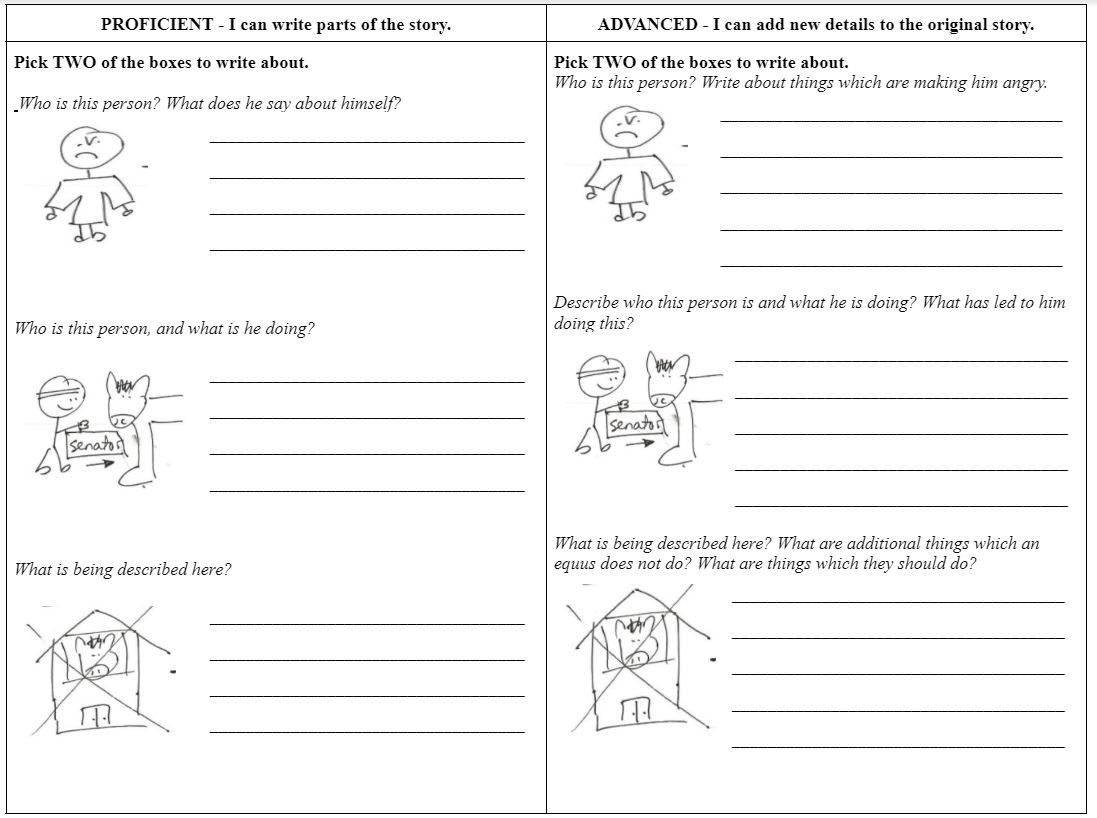
"I Can" Writing Proficiency Check-ins

This is a type of writing check-in/assessment which I have learned while serving as a coach for Martina Bex and Elicia Cardenas' Acquisition Boot Camp (which by the way is a GREAT course for those wanting to learn more about CI/ADI instruction). I am not going to spend time here describing this type of assessment, because Martina does such a good job of this in her blog. Essentially it is a writing check-in/assessment over a current reading where students can choose at which level of writing proficiency with which they are most comfortable for that particular reading. However, to use this type of assessment, a teacher truly must have a good understanding of language proficiency. With what degree of language control are students able to communicate? Words? Simple sentences? Create new language?

Whenever it comes to language output with novice and intermediate language learners, we as teachers need to expect errors (and lots of them!). We need to realize that grammatical mistakes and shaky language control are typical in these proficiency levels; therefore, they are expected and okay! As a result, we need to focus on what it is that students are able to communicate and what we as sympathetic receptors can understand from their messages.

Observations
  1. I absolutely love this how this is set up - thanks, Martina!
  2. I view this type of "assessment" as merely a check-in for students to let me know where they are with the material - what have they acquired so far with the new material? Where are they with language output? Simply, it is a snapshot of their proficiency at the moment, and the snapshot is neither good nor bad. It is simply to inform me (and hopefully students) of where they are at. 
  3. Personally, I do not grade these, but I definitely do look at them. If you look at Martina's original directions, you will see how she grades these according to a proficiency-based rubric.
  4. I like the choice aspect of this, because it gives students permission to proceed at their preferred level of comfort when it comes to written output. Also, within each level, there is a degree of choice so that students can choose those options which will best display their mastery. 

Monday, July 11, 2022

Writing Activities

 I have compiled a list of writing activities about which I have posted on this blog and have put this list on a separate page. It now has its own heading on the menu on the blog home page. You may also access it below:

Writing Activities

Thursday, March 24, 2022

Embedded Writing

This week, I was cleaning out my files in my Google Drive and came across this activity which I had completely forgotten about and have not used for years. It is a post-reading, writing activity which I learned from a conversation that I had with Bess Hayles at NTPRS a number of years ago and then saw demonstrated by Betsy Paskvan. It is a very low-stress, low affective filter way to get students to write without overwhelming them into a full-blown timed/free write. It is very similar to an embedded reading, but this time, students are supplying the missing information. 

Instructions
  1. Take a paragraph from a reading which you have been covering in class. 
  2. Type the sentences out on a document as a list but leave a lined space between each sentence. 
  3. The objective of the activity is very simple: Students' task is to write a sentence of their own in the target language in that lined space which makes sense between the two sentences. It can be an expansion of the sentence of previous sentence, be a transition between the two, or explain the need for the next sentence. Did something happen in the story between the two sentences that is missing? 
Observations
  1. I like this activity, because although students are writing in the target language, they also have parameters in adding new details and meaning to a story.
  2. For beginning levels, you may want to do this as a guided activity first to familiarize students with writing and with the activity itself. For example, for the sentence between #1 and #2, you could ask students aloud, "What is the boy or girl feeling? Happy? sad? Can you describe the boy or girl? Is the boy or girl doing anything?" This will help give students a number of different ideas and details which they could add. Many times I have found that it is not necessarily a lack of vocabulary knowledge which prevents students from writing but rather a lack of direction or ideas to follow.
  3. This is actually a very good higher-order thinking activity, because students must create a sentence of their own which makes sense between two other existing sentences.
  4. Depending on the level of the class and its familiarity with writing, you may choose to leave two lined spaces between each sentence as a higher-level challenge. Students must then write two sentences between each sentence.
  5. I would scaffold this late in a unit lesson plan, because students do need to be familiar enough with the story that they can add new details of their own.
  6. Variations of this activity could be pairing up students or having students pass their papers to another student after they complete writing a sentence, and the next student must write the next new sentence.
Again, I found this activity tucked away in a Google Drive file - I may need to see what else is in my Google Drive!

Thursday, February 10, 2022

Write and Discuss as Pre-Writing Preparation

Update - there is a new blog post detailing "Write and Discuss - the OG version"

Writing in the target language is a skill which we want our students to develop, but so often we give students a topic and say, "Go ahead - write!" Students struggle to put down words, and even as sympathetic readers (an ACTFL term) who are focusing on "Am I able to understand what students are communicating errors and all?", as teachers many times we see that it can be difficult for students to "produce language." I am a firm believer that students cannot output unless they have enough comprehensible input and that students will write when they are ready to write. Personally, I feel like students can never have too much comprehensible input - we want to bathe our students in it to such a degree that as a result, students will naturally overflow with output. So if we are providing students with input, why do they struggle with writing and putting down ideas as output?

A few weeks ago, I gave my Latin 2 students a timed write where the topic was about Incitatus, a novella by Emma Vanderpool which we are reading. We had been back for second semester for 3 1/2 weeks, and I had spent the first week previewing the target vocabulary and structures through a movie talk and a subsequent reading. The following 1 1/2 weeks we read (and re-read!) through the first chapter of Incitatus, and in my opinion, I felt strongly like we had covered it to such a degree that students should be able to write about it, right? I was wrong! Now it wasn't that students could not write, but I could tell that many students were really struggling. My question was why? Was it that students were not ready for it yet? Had I not given them enough input for them to be able to output? Was I pushing them into something which was above their current capabilities? Was I at fault for possibly projecting too high of an expectation on them?

In many ways, there are other factors involved, so I cannot oversimplify the situation and say that comprehensible input is a panacea for all of this. I know that if I were to ask students to write paragraphs in L1, many would struggle even with that. So what are some ways I can assist students in helping them to write in the target language?

In looking over their post-writing reflections, a number of students wrote that we had not done a timed write since Thanksgiving (December was dedicated to exam stuff), so they felt very rusty when it came to an extended write. Other felt that they did not feel like they knew "enough" Latin from the story to answer the prompt. This feedback was very helpful.

This week, we did another timed write, but this time, I did a pre-writing activity the day before to help prepare students for the write. As a class we previewed the writing by doing a Write and Discuss, which is exactly what it sounds like: as a class, you corporately review a story together by asking students to help you retell the story by writing it on the board in the target language, and then you discuss it. We are currently finishing up a Movie Talk reading on The Smoke Seller, so since it was a Movie Talk, I projected screenshots from the animated short as prompts. Each time, I asked students to volunteer responses in Latin for what was happening. I wrote their responses (and edited their grammar when I wrote it but did not call attention to it), and students copied down what I wrote on the board. Many times, I would guide students by asking in both English and in the target language "Who is in the screenshot? What is that person doing? Where is that person? What is emotion of that person?" 

On the next day, we did the actual timed write and used the screenshots as prompts.

Observations

  1. Wow, in their post-writing reflections, students told me that they felt MUCH better about this timed write than the one they did in January. In their post-writing reflections, here is what some students had to say about the Write and Discuss activity: 
    • "Working on how to write and practice really helped." 
    • "The activity yesterday really helped immensely with giving me ideas about what to write." 
    • "Going over the story yesterday helped vocabulary stick to me more." 
    • "I was able to remember details in Latin about the story better."
    • "I felt much more confident in writing this time than before."
  2. This was a great way to review a story corporately together for the purpose of preparing students to write.
  3. Having students write down the sentences as I wrote them down definitely kept students focused and also helped prepare them for the timed write.
  4. Reviewing the story in this manner definitely gave them more understandable input!
  5. Due to the hybrid teaching situation last year, these Latin 2 students are probably more like "Latin 1.5" in terms of their foundational knowledge of the language. This Write and Discuss pre-writing activity truly did give them a lot of support for their actual timed write.

Monday, February 22, 2021

More Observations about Student Grammar Errors

This semester, I am focusing on having students do free writes for their writings. Previously during a normal face-to-face teaching setting, I would have students retell the particular story in Latin which we had been going over for that unit by writing it down in a composition book. Since we had reviewed the story so much as input, writing would be a natural way for output to occur. However, in this digital setting and having students type out their writings of the stories on a Google Document, I soon found that many students were just copying and pasting from digital copies of the story which were already on Google Classroom from previous assignments and submitting that as their writings. As a result, I decided to focus on free writes, where I give students a prompt for them to complete, and their job is create a sequel to the story on their own from that prompt.

Here are some examples of Latin 3 student writing based on the prompt which my colleague John Foulk created: Monstrum et puer nunc sunt amīcī. Cum monstrum et puer aquae appropinquant, subitō…

Example 1

Monstrum gaudet. Monstrum est laetus. Monstrum est lateus qoud amici habet. Monstrum numcam habet amici. Monstrum non queritur dentes e ocolus. Subitio de aquae Peppa pig surgit. Peppa vult cibum. Peppa dicit “puer dat cibum NUNC!” Puer timet. Monstum non placet Peppa.Puer est eius amici, non vult puer timit sed vult puer lateus. Monstrum petit Peppa. Peppa  pettit monstrum. Petit e petit e petit Subito Peppa cadit in Aquea et perit. Puer est lateus sed non iam timet. Peur est latues quod oculous habet et puer potest videre monstrum est un amici.Monstrum et Puer ambulat ad tabernam. Subito Peppa surgit et didct “redibo”. “Non iam pax in gens sed bellum, bellum gerit contra puer et monstrum.”


Example 2

Puer cadit in aquae. Puer non potest natare. Puer est patitur. Monstrum nonscivit liberate puer. Monstrum parat videt mortuus est puer. Monstrum est tristis et patitur, videt drowning puer. Monstrum tristissimus et fugit ex from aquae. Monstrum in dolore et searches for miles ut liberate puer. Monstrum et miles fugit ad puer, sed puer non iam in aquae. Iam puer cum piratae. Piratae liberavit puer et nunc puer est piratae. Pirataes non placet monstrum. Pirataes bellum gerit monstrum. Sed Monstrum fortissimus. Monstrum caedet pirataes et pirataes nunc mortuom. Monstrum vicit pirataes et nunc odit puer. Puer est vulneratus et non iam placet Monstrum. Puer odit Monstrum. Puer fugit ab ex monstrum. Puer videt aliud monstrum sed non amici est. Nunc Puer odit et ab fugit omnes monstrum.


Example 3

Imperator appropinquant. Imperator fortis et audax. Imperator habet arma et vult bellum gerit. Imperator of Bikini Bottom ingens et cancer. Monstrum et puer timet. Monstrum et puer vult pax, non vult proelio. Monstrum iubet ut pax. Imperator iratus et non vult pax. Imperator cadit in terra. Imperator manet in terra. Imperator patitur sed imperator vulneteratus. Imperator non iam vult bellum gerrit. Monstrum, puer, et imperator nunc sunt amici. Subito, regina Sandy appropinquant. Sandy considit in terra, Bikini Bottom. Monstrum, puer, et imperator considit in terra. Imperator audit Patrick et SpongeBob mortus. Imperator iratus et non lauetus. Imperator in dolore. Monstrum et puer in dolore. Omnes Bikini Bottom patitur. Pauci homines such as Squidward non patitur et guadit. Squidward laetus et canit carmen. Monstrum, imperator, puer, et Sandy non nunc sunt amici with Squidward. Omnes iratus at Squidward. Imperator et Sandy videt taberna. Imperator, Sandy, monstrum, et puer vult comedere.


Now if you are familiar with Latin, the first thing which I am sure that stands out to you is the SHEER AMOUNT of grammar and spelling errors! And I am certain that for many of you, it is very PAINFUL to read. However, if I view these writings through the lens of a sympathetic reader (an ACTFL term), then wow, these students are communicating in the language! Even though these are Latin 3 students, in terms of language acquisition, knowledge, and grammar control, they are novice-high/intermediate-low writers. If my students were children learning their first language, they would be equivalent to 2-3 year-olds. As a result, their language is going to be incredibly MESSY! To use an example from Bill Van Patten, when a 2-year old says, "Mommy go bye-bye," do you correct that child's grammar and choice of vocabulary? Absolutely not, because you as a sympathetic listener know exactly what that child is attempting to communicate. That child is piecing together whatever vocabulary has been acquired to communicate. You can try to correct that child, but we know that the child's language will improve over time with more input and exposure.

I have used this illustration before, but it is so true!


Why can I relate to the above illustraion? Because the first time I truly spoke Latin in 2010 at Rusticatio, a weeklong immersion event, everything that came out of my mouth was in the nominative case and in infintives. Keep in mind, I have my Masters in Latin, but when it came to truly speaking in Latin for the purpose of communication and conversation (something which I had never done before), I was a novice - a very LOW novice. My grammar was horrible! Case endings, verb endings, and subject/verb agreement went out the window, because all i could do was just get vocabuary to come out of my mouth - any vocabulary!! 

I love Nancy Llewellyn's quote which she traditionally gave in her opening talk at Rusticatio:

You are going to make the same kinds of grammar errors that if your own students were to make them, you would skin your knees running to grab a red pen to correct them. So be patient with yourself.

That was ten years ago. I can say that I am probably an Intermediate High level speaker now, but I still definitely struggle trying to put it all together with correct case endings, subject/verb agreement, correct usage of subjunctives, noun/adjective agreeement, pronunication, etc.

So when getting students to write in the target language, be sure that there has been plenty of input first so that there is a natural overflow of output, but be prepared for it to be messy. However, if you are viewing the output from a proficiency viewpoint instead of a performance lens, you will be amazed by what students are attempting to communicate in the language.

Wednesday, October 30, 2019

Running Dictation with Categories

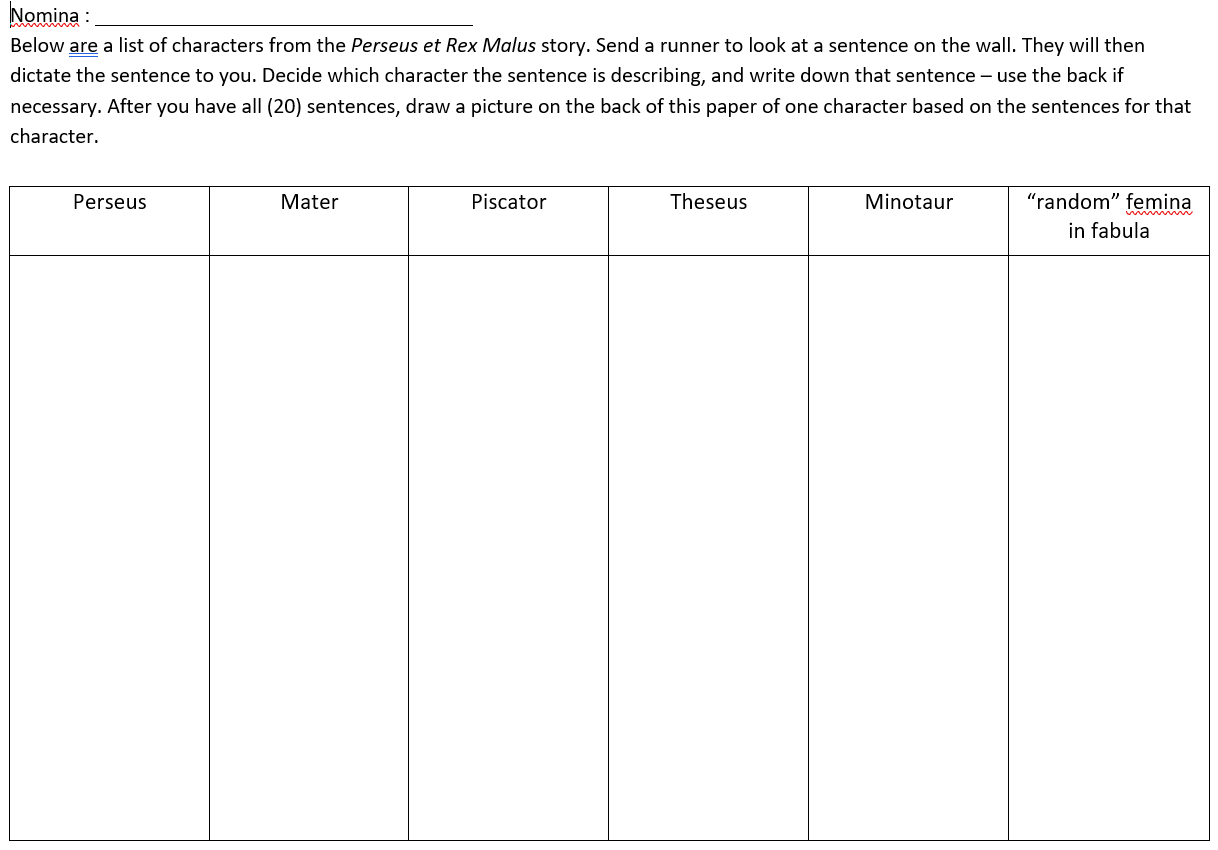
This is a take on a regular running dictation which I learned from Miriam Patrick. This is a great post-reading activity involving characters from a reading or sentences involving categories. It still has the basics of a running dictation where a runner will run to a list of sentences in the target language, memorize what is written, and then dictate what is said to a writer. This twist, however, has the writer put the sentence now in a particular category.

Pre-Class Directions
  1. On a document, create a number of categories, such as characters in a reading or other natural categories. 4-5 categories are a good amount.
  2. Write short sentences in the target language for each category. 4-5 sentences for each category are a good amount.
  3. Scatter the sentences on a document so that all of the sentences are not grouped by category.
Classtime
  1. Put up the sentences along a wall in a random order either in the room or outside of the classroom. You can post copies of the document. I recommended making one copy of the sentences, cutting the sentences into strips, and taping them to an outside wall.
  2. Pair up students.
  3. Each team will need a writing surface and a writing utensil.
  4. Give each team a copy of the category document.
  5. Explain that one person will sit with sentences and the other person will run to ONE of the sentences. It is not necessary for them to run to the sentences in order but rather to run to just one of the them.
  6. The person who runs will look at the sentence, memorize it, run back to the partner, and dictate the sentence in the target language.
  7. Both members will then determine into which category that sentence that goes, and the writer will write that sentence under that category heading.
  8. Then, the two will switch roles - the writer will now become the runner, and the runner will then become the writer.
  9. Explain that they may NOT use their phones to take a picture! They again can only look at one sentence at a time.
Example:


Non est defessus
Exclamat “Narra fabulam mihi”
Ludit (is playing) cum amicis in silva
Habitat in parva insula
Iecit rete in mare
Vidit aliquid in mari
Putavit arcam esse navem
Est defessa, sed narrat fabulam
Non vult narrare fabulam
Vult matrem narrare fabulam
Est monstrum
Est in Labyrintho
Habet caput tauri
Est in arca
Est cum parvo infante in arca
Invenit feminam in arca
Vendit pisces
Accepit nummum
Vult caedere Minotaurum
Non vult auxilio esse (to help) patri
Observations
  1. This is a quick post-reading activity and takes about 10 minutes.
  2. I love the higher-level thinking that goes on in this activity. Instead of just parroting back sentences, students are using the sentences for a reason (a "task" perhaps), which is putting the sentences into categories.
  3. This is also a higher-level thinking activity, because runners and writers need to communicate to each other which sentences they already have.
  4. The sentences need to be short, since runners are dictating them for a purpose. It frustrates students to have long sentences where they have to keep running back to the sentence.
  5. The sentences need to be comprehensible, since the both the runner and writer need to understand the message communicated.
  6. I love the multiple layers of input which is going on - the runner reading the sentence and then dictating it to the writer, who is listening and writing it down.
  7. I like cutting up the strips and posting them all over the walls outside the classroom, because students are moving all over the place and really start to read each sentence as the activity progresses to determine if their team already has that sentence.