Showing posts with label choice. Show all posts

Monday, August 1, 2022

"I Can" Writing Proficiency Check-ins

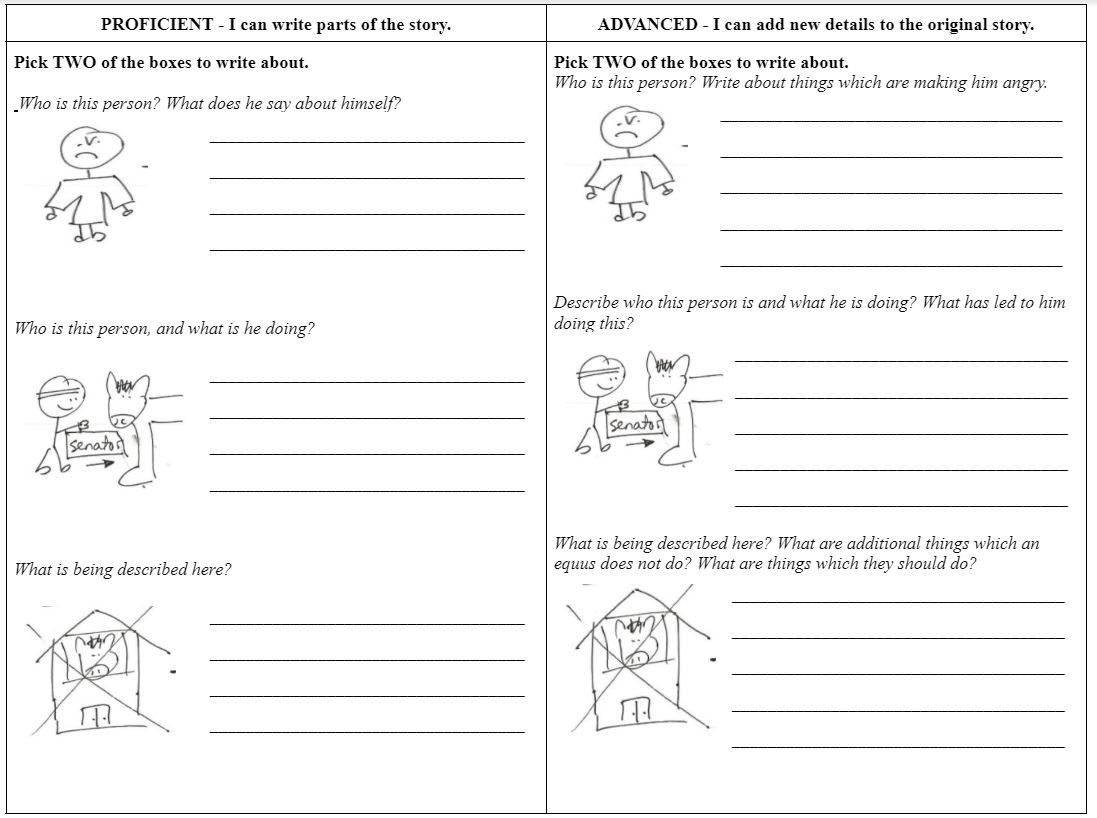
This is a type of writing check-in/assessment which I have learned while serving as a coach for Martina Bex and Elicia Cardenas' Acquisition Boot Camp (which by the way is a GREAT course for those wanting to learn more about CI/ADI instruction). I am not going to spend time here describing this type of assessment, because Martina does such a good job of this in her blog. Essentially it is a writing check-in/assessment over a current reading where students can choose at which level of writing proficiency with which they are most comfortable for that particular reading. However, to use this type of assessment, a teacher truly must have a good understanding of language proficiency. With what degree of language control are students able to communicate? Words? Simple sentences? Create new language?

Whenever it comes to language output with novice and intermediate language learners, we as teachers need to expect errors (and lots of them!). We need to realize that grammatical mistakes and shaky language control are typical in these proficiency levels; therefore, they are expected and okay! As a result, we need to focus on what it is that students are able to communicate and what we as sympathetic receptors can understand from their messages.

Observations
  1. I absolutely love this how this is set up - thanks, Martina!
  2. I view this type of "assessment" as merely a check-in for students to let me know where they are with the material - what have they acquired so far with the new material? Where are they with language output? Simply, it is a snapshot of their proficiency at the moment, and the snapshot is neither good nor bad. It is simply to inform me (and hopefully students) of where they are at. 
  3. Personally, I do not grade these, but I definitely do look at them. If you look at Martina's original directions, you will see how she grades these according to a proficiency-based rubric.
  4. I like the choice aspect of this, because it gives students permission to proceed at their preferred level of comfort when it comes to written output. Also, within each level, there is a degree of choice so that students can choose those options which will best display their mastery. 

Thursday, February 24, 2022

Easy Ways to Begin Giving Students Choice and Differentiation

One of the current buzzwords and phrases in education is student choice, or more commonly known as differentiated instruction. To a degree as language teachers, we are probably already addressing differentiated instruction, since language encompasses so many different modalities of input/output such as listening, reading, writing, and speaking. How can we allow students to learn and to demonstrate mastery in a way which best suits them and their interests?

Let me say that the topic of student choice/differentiated instruction is HUGE and cannot be fully addressed in a single blog post, nor do I want to oversimplify the topic. However, here are some initial ways/baby steps in which you can modify some of your current activities/assessments to begin implementing student choice:

  • On any type of written assessment (outside of final exams and other standardized assessments), give students choice of the minimum number of questions which they must answer to demonstrate mastery; anything which they answer beyond that correctly can count towards backup credit. For example, if you give 10 questions, students only have to answer 8 of them but may answer more as backup credit. On a recent sight reading comprehension assessment which I gave, there were three sections which students had to address. However, these were the directions for each section:

    • 1) Main Idea - pick TWO of the details below to answer in English. You may answer all three as backup credit:
    • 2) Details: Marcus experiences a number of different emotions in this reading. Pick TWO of them to answer in English and explain why he feels that way according to the story. You may answer all three as backup credit.
    • 3) Drawing Conclusions: Answer ONE of the following questions in English. You may answer both as backup credit.

  • For formative listening comprehension assessments such as a dictation, give students the option to either draw a picture of what they hear or to write out a translation of what you are dictating. Do not mark errors in a translation unless it does not demonstrate comprehension.
  • Culture Choice - when addressing a cultural topic, give students a choice of aspects of the topic to address. Last week in my Latin 2 classes, since we are reading Emma Vanderpool's Incitatus (a horse whom the Roman emperor Caligula made a senator - yes, most likely this did happen in history!), I wanted students to learn about Caligula (not an easy topic to address if you know anything about him). It turned into a 2-day in-class assignment where on day 1, they took notes on an article called "Caligula - The Embodiment of Cruelty." However, on Day 2, students then had a choice of topics about which to read which focused on "the other side of Caligula". Students then had a Google Form to complete where they used their notes from the Day1 article combined with whichever Day 2 topic they chose in order to "reconcile both sides" of Caligula: 

Observations
  1. I have found that when it comes to assessment questions, students are VERY appreciative of having the choice of which questions to answer. While I have found that most students will indeed answer all of them, there are those who like that they do not have to answer every question, especially if they do not know the answers to those questions! In giving students a choice of which questions to answer, they are able to demonstrate mastery to me in those areas where they feel successful. 
  2. In a drawing dictation, I love giving students the choice of drawing or translating what they hear me dictate. In either choice, students are demonstrating comprehension in the way which feels best for them at that moment. Plus, I have students who HATE drawing!
  3. The Caligula Choice Board went very well, and I was very pleased at what students had to say about this emperor based on the Day 1 article and their Day 2 topic choice. No one topic was chosen over the others, so students apparently were able to pick something which interested them.