Showing posts sorted by date for query purposeful communication. Sort by relevance Show all posts

Wednesday, January 7, 2026

Revisiting Dictations - Embedding Purposeful Communication

I am not a fan of dictations. I find them boring, and while I understand how they can aid in both the acquisition of language and the creation of orthographic mapping in students' minds, my students really do not like them. One student told me, "This is like taking notes!"

I am currently reading Common Ground: Second Language Acquisition Theory Goes to the Classroom by Maris Hawkins and Florencia Henshaw. In the first chapter, Hawkins and Henshaw discuss how to transform traditional activities into ones which reflect a communicative aspect; among these, they discuss a dictation. This can be found on pages 17-18 (according to my Kindle, so the pages may be different in a hard copy).

I tried out this modified dictation today in my Latin 1 classes, and I really like how it went. I did make some changes to how they present it in their book, but the spirit is still the same. I TAKE NO CREDIT FOR THE FOLLOWING - THIS IS ALL HAWKINS AND HENSHAW!

As is the example in the book, the focus of my dictation was on introducing the phrase "I like" (in Latin, mihi placet - literally "it pleases me").

  1. I looked online to find the top six ranked activities which American teenagers like to do. I used Gemini AI to help find the ranked activities (so take with a grain of salt the accuracy), but according to a 2025 Pew Report as found by AI, the top six activities in order are:
    1. watching digital content (Disney +, Hulu, Netflix, etc)
    2. being on social media (Tik Tok, Instagram, Snapchat, Discord, etc)
    3. listening to music
    4. playing video games
    5. sleeping
    6. playing sports
  2. I then scrambled the order and wrote them up as dictation sentences in Latin with the phrase "mihi placet....". There were a number of words and phrases for which I had to establish meaning in English and Latin: social media, video games, to watch digital content. 
  3. From here, I treated this as a regular dictation activity.
  4. Once the dictation activity was done, I then asked students to rank these activities from 1-6 according to THEIR preference.
  5. Then I asked them to rank these activities according to how they thought AMERICAN TEENAGERS had answered.
  6. I then projected a slide, revealing the Pew Report answers in Latin one at a time, starting with #6. 
Observations
  1. While it still was a traditional dictation in a way, I loved the purposeful communication aspect of it at the end. Students were learning about themselves and their interests compared to how they "ranked" on a national poll.
  2. I felt that having students rank their interests at the end according to their preferences and then predict what American teenagers said gave a sense of anticipation when I revealed the rankings - it felt like a game show! 
  3. As a teacher, I definitely felt more engaged in the activity, since I knew where the dictation was heading. Most times, I end up zoning out... 
  4. In Latin, much like Spanish, the phrase "I like" is usually followed by an infinitive. I had not yet introduced the infinitive form, but because I had sheltered vocabulary last semester, students already knew the verb forms for hear/listen to, play, and sleep. So while I still established meaning for the infinitive forms during the dictation, I was able to do lots of quick pop-up grammar during it by saying, "You already know that ludit means 'plays' - ludere means 'to play' - the -re is where I am getting the 'to __________." Using the phrase "I like" seems like a natural way to introduce the infinitive of known verbs.
I would love to do more purposefully communicative dictations in the future - what are some suggestions which you all have?

Thank you, Maris Hawkins and Florencia Henshaw!

Monday, December 15, 2025

Top 5 of 2025

It is nearing the end of the year, and as always, I wish to thank all of you who read my blog and walk away having learned something or feel encouraged or even challenged. At the ACTFL Convention in New Orleans a few weeks ago, it was so nice to meet many of you in person - I definitely appreciate the kinds words which you passed along to me.

I was taking a look over what I have posted this year, and I see that there were two topics about which I seemed to address often: proficiency-based grading vs. performance-based grading, and literacy/the science of reading. These two subjects continue to intrigue me and what they look like in a CI/ADI classroom. I hope to learn more about these topics in 2026, so possibly expect more blog posts about them next year. I have been learning much about the science of reading and how to apply that to a CI/ADI curriculum - I am excited to share much of that with you all in 2026!

So as is tradition, I list here the top 5 viewed blog posts of 2025: 

  1. The Necessity of Background Language Knowledge for Reading in the CI/ADI Classroom 
  2. Translation Rubric 
  3. Novellas - Balancing Comprehensibility and Compelling 
  4. Left/Right PQAs - Purposeful Communication 
  5. Spanish Confidence Readers by Adam Giedd 
I began this blog in December 2013, and 463 posts later (and over 1,450,000 page views - wow!!!), I am amazed that I still have not run out of things about which to write. I hope that your school year ends well, and I look forward to 2026!

Tuesday, November 25, 2025

ACTFL Presentation - Detoxing from the Textbook: Creating a Purposefully Communicative Classroom

This past weekend was the the annual ACTFL Convention, this year in New Orleans. I had the privilege of presenting this year, and I was deeply honored that my presentation was sponsored by the Comprehension-Based Communicative Language Teaching SIG (special interest group). My topic was Detoxing from the Textbook: Creating a Purposefully Communicative Classroom, and it was a updated (much needed) version of a presentation which I had given in 2016 but now focusing on purposeful communication. 

Below is a modified document of my presentation which I posted if you wish to check it out. 

Detoxing from the Textbook: Creating a Purposefully Communicative Classroom - PDF


Saturday, November 8, 2025

Guided Choice Writing

As I have posted earlier, I am teaching Latin 1 again and am doing things much differently than I have in the past. So much of this is due to my own increased understanding of what is considered realistic language proficiency at this level (Novice Lowish) and that in many ways in the past, my own expectations of student proficiency for Latin 1 were wrong. I have focused on sheltering vocabulary BIG TIME, targeting high frequency words, with the intent of going "deep and simple" and not "shallow and complex."

As a result, when it has come to writing, I have been experimenting with students doing "guided writes" instead of doing timed writes. In a "guided write," like the name states, I am guiding students through what I want them to write for the creation of a story, since they are novice low writers. There is a degree of student choice where they can add their own details, but I tell them EXACTLY what they are to write for each sentence based on a word bank. I am also only focusing on words which we have been targeting. Below are some examples from throughout the semester:

Week 6


Week 10

Week 14

Student examples


Observations
  1. If you take a look at the three examples, you can see that I keep adding more details or focus on different aspects as the semester progresses. In the last example, you can see that the focus is on creating guided longer, compound sentences using and and because.
  2. I like the guided aspect, because for these novice-low students, I do not think that they are ready to just "write" without very specific parameters
  3. In many ways, the sentences are like those in Rotating Desks where I am telling students what to write and that they have choice in adding details.
  4. This is a form of purposeful communication on a low level, since students are playing around with the language by choosing their own details to add. 
  5. Will students' grammar be correct? Most likely, no! BUT I also have NO expectations of it to be, since they are novice low learners. I am only interested in "Are they communicating in a way which I as a sympathetic receptor can understand?" I cannot tell you HOW FREEING that perspective is as a teacher!
  6. Even though I am telling students what to write, hopefully as they write these sentences, students are understanding those messages which they are writing. Thus, this is adding to/refining their mental representation of the language. 
  7. This is a precursor to the 4-Word Story writing activity which I will introduce to them next semester. By then, these students should have a foundation where they can write more freely on their own.
Have you done something like this? If not, give it a try, and let me know how it goes!

Friday, September 12, 2025

Rotating Desks

If you have not gotten a copy of Eric Richards’ book “Grafted Writing,” please do so. In it, he details numerous ways to get students writing in a very guided manner - this is great for beginning writers! One of his ideas is called “Rotating Desks.” At the 2023 CI Summit in Savannah where Eric demonstrated numerous strategies from his book, I took part in this activity, and it is a lot of fun!

Directions (his and my adaptation)

  1. Choose a text (or write your own), and use it to create a projectable slide presentation.
  2. Remove an element from each slide, such as vocabulary or grammar, to create “blanks.” 
  3. Label the blanks with the missing element (“noun,” etc.) so the students will know what they are looking for. Students will be adding their own details based on the "blank" description.
  4. After you have created the presentation, you can do the following activity in class. First, have students start with a whiteboard (write their names on their boards) at the top but small OR use a piece of paper.
  5. Then project slide one on the board. Students will write down the entire text from the slide and insert the missing elements/new details. Tell them to write small because there are a number of sentences.
  6. Students rotate to the next desk, but the paper/whiteboard STAYS. Teacher projects slide two. Students read the previous sentence and then add the content of slide two to the paper/whiteboard.
  7. Repeat until slides are done.
  8. Students return to their desks and read them.
  9. MY ADAPTATION - since I am in a trailer this year and am deskless, students used whiteboards, and the whiteboards "rotated" for each slide.

Here is what I recently did with my Latin 1’s:

  1. Puer est in (name of place/ store/ city).
  2. Is est (size) puer.
  3. Ei nomen est (name).
  4. Is (name of female cartoon character/ female singer / female celebrity) videt.
  5. (name from #4) est tristis, et habet (name of object / thing/ food).
  6. Puer (different object / food/ thing) fert.
  7. (name from #4) non puerum amat, sed (name of male cartoon character / male singer / male celebrity).   
Student example (in English):
1) A boy is in Buc-ees.
2) He is a big boy.
3) His name is Oscar.
4) He sees GloRilla.
5) GloRilla is sad and has a CrockPot.
6) The boy brings Takis.
7) GloRilla does not love the boy but Cookie Monster.

Observations
  1. I love this activity on SO MANY levels! I do not know where to begin. This activity definitely has a Mad-Libs feel to it. 
  2. First, I love the guided output aspect of it. Although I am telling students what to write (and those messages are hopefully 100% comprehensible for them!), there still is a degree of choice for them of what details to add.
  3. This is a GREAT example of purposeful communication, because students are playing with the language in adding their own details.
  4. This is a written form of TPRS/Storyasking! Instead of asking students to come up with details orally, they write them down instead.
  5. Because I am asking them to write down known vocabulary and phrases, students are getting repetitions of understandable language in a context which adds to/modifies/enlarges their brain's mental representation of Latin.
  6. When students get a new whiteboard, they must read what has already been written before they can move onto writing the new sentence. What they read should already be 100% comprehensible by this point, because A) the sentence frames are recycling known phrases and words from class but also B) students have already interacted with those sentences by writing them down on the whiteboard.
  7. I loved hearing students laugh when they got back their original whiteboard and read what students had added!

Consider adding this to your toolbox of writing activities!

Thursday, August 28, 2025

Trying Out What I Learned This Summer

I have now been back with students for 3 1/2 weeks - I started with students on Monday, August 4 after seven days of pre-planning which began on Thursday, July 24! This past summer, I attended both Comprehensible Iowa and CI Summit, and I came away from both conferences with many new strategies which I was wanting to try out in this new school year. Here are those strategies which I have begun to implement:

  • Magic Cards - I learned this from AnneMarie Chase at CI Summit, and it is SUCH AN EASY way to call on students and to assess them in the moment for a formative grade - no more popsicle sticks! It simply involves a 3x5 card which students fill out in the beginning of the semester, and you keep it on hand. I have been using them to call on students for bellringers, and they are so easy to use!
  • Left/Right PQA's - I learned this from Eric Richards at Comprehensible Iowa when we co-led the German workshop lab, and he then facilitated it in his German lab at CI Summit. It is a great way to implement movement in a class while asking PQAs - it definitely exemplifies purposeful communication. Last week, I just happened to be observed by an administrator when I was doing a Left/Right activity (students had to guess in Latin which was the most popular sports in certain countries by moving to X side of the classroom), and he thought it was such a great kinesthetic activity!
  • Write and Discuss - Although I have known about Write and Discuss for awhile, I never really used them properly as intended. I primarily had used them the day before a timed write to prepare students, but I have since learned that a Write and Discuss is something which should be done as often as possible as a way to review that day's material. At CI Summit, I saw Andrea Schweitzer do this with a One Word Image which she had created in Spanish with our squad. I now see the power of a Write and Discuss in giving students another added layer of input as a review. Although I am now slowly implementing Write and Discusses as a review, my goal is to facilitate them as often as possible.
What is a CI strategy which you learned this summer which you wish to implement?

Friday, August 1, 2025

My School Year is Beginning

Today was my last day of pre-planning - I had SEVEN days of in-service (yes, seven, count 'em, seven!) and still did not have enough time to get everything done that I needed to. Students return on Monday - my summer break is over. It definitely went by too fast, and it is not like I did a whole lot during that time. I attended two CI conferences: CI Iowa in mid-June, and CI Summit towards the end of July. The rest of the time I was basically a bum hanging out.

However, as unprepared as I feel for Monday (does anyone ever feel 100% prepared for the first day of school?), I will admit that I do feel a sense of joy about it. Weird, huh? As much as I am still wanting my summer break to continue and as exhausted as I am at the moment from pre-planning, I am excited to be back in the classroom. I am excited to implement so many new strategies which I learned this summer. I am excited to further my journey into purposeful communication. I am excited to meet my students (of which I probably only know about 20% of them from last year) and to see them acquire Latin this year.

I am certain that I will get no sleep on Sunday night and that on Monday morning before the 1st period bell rings, I will be an absolute nervous wreck. But after 28 years of teaching, I also know that once that bell rings and I open my mouth to welcome my students, I will instantly be back in teacher mode and ready to start. 

So for those of you who are starting school or have already started, I wish you joy too. And for those of you who do not start until Labor Day and still have a month left, enjoy your time away from students, and when my school year is finished before Memorial Day, I will think of you as you labor until mid-June haha!

Wednesday, June 18, 2025

Left/Right PQAs - Purposeful Communication

This past weekend, I attended/presented at Comprehensible Iowa in Des Moines. This was my second time attending/presenting at this local conference, and again, it did not disappoint at all! I truly love Comprehensible Iowa (you can read my post about it from last year), because the organizers put on a such a great conference - lots of very good presenters, a very communal and welcoming Midwestern atmosphere, a great social gathering following the Friday workshops, and plenty of food and snacks!

On the first day, I co-presented a 3-hour adult German language lab with Eric Richards - since Eric is a German teacher, he did most of the heavy lifting in leading it, while I led the debriefs. Because of this, I was able to participate in the language lab; I absolutely LOVE being a participant in language labs where I do not know the language, because then I can experience learning a language like one of my own students. Years ago, being in Linda Li's Mandarin Fluency Fast class was such a turning point for me in my CI/ADI journey, and Eric is a master at implementing CI/ADI as a German teacher! Every time I sit on a German session led by Eric, I learn so much from him.

One activity which Eric facilitated during this language lab was Left/Right. Eric wrote the words "links (left)" and "recht (right)" on the appropriate sides of the board and then projected a question slide similar to this one:

Our job was then to move to the proper side of the board which best reflected our answer. Although a very simple activity, Eric did SO much with this:
  1. After we had moved to our sides, Eric counted us in German and then said in German, "X have brothers." Then depending on the numbers, he said, "More do have (not) a brother. Most have (not) a brother."
  2. He then in German asked some of those who had brothers "Is your brother older or younger? Do you have one brother? Is your brother friendly? What is your brother's name?"
  3. From then, Eric projected a new slide asking us a new question, and as previously done, he repeated the same pattern of questions.
I absolutely LOVED this activity which Eric did for so many reasons:
  1. Even though the activity was in German, Eric had scaffolded the lesson already to such a degree that the necessary vocabulary had already been previewed and meaning established, so it was incredibly comprehensible for us.
  2. It was a wonderful example of purposeful communication in that all of us participants were able to learn about each other nonverbally based on what side of the board we were standing and then verbally through Eric's followup questions.
  3. The movement aspect made the activity quite compelling and novel, instead of the traditional "raise your hand" kind of response.
  4. This activity was done throughout the 3 hours so although each time it involved a new set of questions, we became very familiar with it.
  5. Eric changed up the slides so that not every one was necessarily a question, e.g., "I swim __________" (left - good, right - bad); "I have a _________" (left - iphone, right - Android phone); "I need more ________" (left - luck, right - patience). I not only loved how our responses were not always to a question but that Eric snuck in the first person singular forms. However, since the focus for us participants was not on grammar per se but rather on the activity, I do not think I even noticed that the form of the verb had changed. 
  6. Although it started out as a group PQA, by Eric then asking individuals about their answers, it turned into an individual PQA. Eric did a master job at "keeping the balloon in the air" (I think this is a Ben Slavic phrase?) with questions until he felt that it was time to move on.
This is just one of the many CI/ADI strategies which I learned this past weekend at CI Iowa, and I will be blogging about them. I hope that you will consider attending CI Iowa in summer 2026 - I am already planning to attend, so I hope to see you there!

P.S. If you are attending CI Summit next month, Eric will be leading the German language study class and will be doing this activity as part of the lab. Consider taking the German class, because you are in for a treat! 

Wednesday, January 15, 2025

Purposeful Communication through Pets

I have been back in school for a 1.5 weeks now (even throw in a snow day here in Atlanta!). Since it is the beginning of a new semester, with my Latin 1 students, I want to focus this semester on readings involving animals. I also really wanted to get back into being purposefully communicative with them (I feel like I began to slack off last semester). 

Remember that in purposeful communication, our goals are to learn about ourselves, each other, and the world around us. These goals are what guided this multi-day activity.

Anne Marie Chase (Senora Chase) has a great lesson about Picture Talks/PQAs involving students and their pets, along with a Google Slide in different languages which you can download. I implemented this and then extended it into purposeful communication.

Day 1

  • Assignment - students filled out the Latin Google Slide as an assignment on Google Classroom. Each student was assigned just one slide to fill out, instead of a class slide which everyone filled out.
Days 2, 3, and 4
  • I picked slides to project and did a few Picture Talks with students about their pet(s). The slide has all of the language/established meaning there on it. I only spent out 10 minutes/day on this.
  • A way to extend the activity and to bring up past knowledge is to ask students about earlier slides from days past: "Who has a cat named Mr. Whiskers?" "Who wants a small lion?" etc.
Day 4 
  • This is something which I learned from Bill Van Patten and then saw demonstrated again at this past ACTFL. After the last round of Picture Talks on Day 4, I then projected the following slide (CFA is the Latin abbreviation for the United States of America - Civitates Foederatae Americae):
  • Using the chart, I began asking in Latin: "In America, what animals do most Americans have? In America, what animals do fewest Americans have?" From there, I began asking individual students in Latin, "Do you have a fish? Do you have a reptile?” to see if their pet reflected the chart.
  • I then asked students to raise their hands when asked in Latin “Who has a dog?” “Who has a cat?” Draw attention that the class most likely reflects America in respect to pets: “Most students also have a dog. Fewest students have a bird or reptile." This took about 10 minutes.
Observations
  1. Students actually want to talk about their pets, so a personalized Picture Talk is a great way for students to learn about each other.
  2. It is a very easy, comprehensible activity to do with level 1 students.
  3. If possible, consider creating a slide of your own and talking about your pet(s) you have or want. I do not have a pet but I am 100% a dog guy! Let students learn about you!
  4. Extending this communication to learning about the world around them and then comparing it to students' own lives is not that difficult and is rather a natural extension.
Give this a try - thanks, Anne Marie!

Tuesday, November 12, 2024

Purposeful Communication with Movement: A Collaborative Blog Post with Eric Richards

This is a continuation in my series on purposeful communication.

This is my first of what I hope are many collaborative posts with Eric Richards. I first met Eric at the 2023 CI Summit in Savannah. Both of us were assigned to serve as team members/trainers for the same cohort (woohoo - go Cohort 2 with Gary DiBianca and Andrea Schweitzer!). Although I had never formally met Eric before, I did know of his name (and that he was an ACTFL Teacher of the Year Finalist for 2021!) and had seen him present digitally at the 2023 Voces Digital Spring Conference - I was very impressed with both his presentation and very comfortable online demeanor and delivery. When Eric and I were on the same team, we hit it off, and since he teaches German and I am a Latin teacher, we were the ones tasked with doing the cohort L2 demonstrations since the majority of teachers in the cohort were Spanish and French teachers. I always learn so much about CI/ADI pedagogy from taking part in/observing L2 demos where I do not know that language, so I was able to see Eric daily demo PQAs in German (and a later presentation on writing) - all of Eric's demos/presentations were so good that I have now "Latinized" his first week PQA lessons for my own classes!

Anyhow, Eric recently wrote up a post on his own blog about his reflections on my presentation on purposeful communication at Comprehensible Iowa this past summer (read his post - it is a good one!). He had also emailed me about how he implemented a purposeful communicative activity involving movement with his classes similar to my pizza topping bellringer, which in turn motivated me to facilitate one based on his list of PQA questions. 

As a result, I asked Eric to write up his experience for this blog, and in turn, I would then add my own activity inspired by this. I hope that you will enjoy and learn from our posts here!

Eric Richards - Four Squares for more Purposeful Communication 

This school year, I’ve been considering the role of communication in the classroom, how I deliver content, and how I engage with my students. As I gave thought to this, I realized that I need to adjust the way I communicate and how I approach some activities in class. I need to be more purposeful in my communication and engagement with my students.

That is, I need to communicate (more) in a way that allows me and my students to:

  • learn about each other and ourselves (build our relationships through language)

  • learn about the world around us (learning information)

  • entertain/create with language in fun, engaging ways (language play)

But why?

According to Bill Van Patten, “Language use without purpose is not communication.” That is, we may be using the language, but without purpose, communication may not be happening – and I definitely want communication to happen in my classroom!

(Let’s fast forward a bit.)

As I adjusted lesson plans for this school year to better meet my goals, I started thinking about if there was a way to get a little extra “bang for your buck” with the activities. After a bit of reflection, it hit me – incorporate more movement with the activities!


But, before we move on, let’s quickly review a few reasons why movement in the classroom is beneficial (for both students and teachers):

  • Increased Focus and Attention: Short movement breaks or incorporating physical activity helps students refresh their minds, improving focus and concentration.

  • Enhanced Learning and Memory: Movement activates multiple areas of the brain, which enhances learning, memory retention, and cognitive function. 

  • Improved Behavior and Reduced Disruptions: Regular movement opportunities help reduce restlessness and behavioral issues. (Plus, it supports kinesthetic learning.)

  • Increased Engagement and Enjoyment: Incorporating movement makes learning more engaging, which can help increase student interest.

So, with that in mind, I began incorporating movement into my lessons. Note: I kept it simple! I was not about to reinvent the wheel, and I sure was not going to throw all my lessons out and start over! As they say, “Ain’t nobody got time for that!”


Here is what I did: 


I made a quadrant in the middle of the room. (I have a deskless classroom, but you can simply label 4 corners/areas in your classroom to substitute the quadrant, if you don’t have space.)

That’s it!

Then, I started incorporating movement into activities that helped me achieve more purposeful communication. Note: I sometimes incorporate movement activities at the beginning of class and sometimes at the middle or end. It just depends.

Also, did I mention that I kept it simple?

Here are some examples of the activities:

I use this one the second day of German I. We are focusing on (very) good / (very) bad.

  • This is another activity from the first week of German I. Once they are comfortable the structure, e.g., “Can you play ____?”, you can incorporate a new vocabulary word (using both text and pictures):
  • Again, don’t reinvent the wheel! Use what you have and simply build on it! In this example, I simply added “good (well)” to an already familiar structure. It allows you to build in new vocabulary while also changing the “feel” of the question.

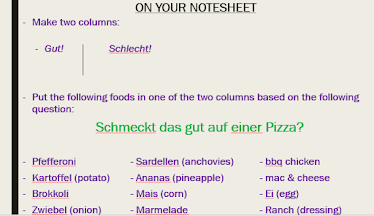
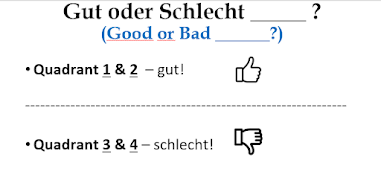
Here is another example of how you can level an activity. In this pizza topping activity, which I stole from Keith Toda, I had them sort the toppings on their note sheets (paper) according to how each student liked – or disliked – a topping. Then, they got up and moved accordingly (in the quadrant - good or bad -) as we had a discussion. Again, I repeat, don’t reinvent the wheel! Take what you have and level it up and down where you can!


As this was in German II, I led the discussion and questions at a more appropriate level. Obviously, they know “good” and “bad”, so I incorporated vocabulary like "majority" and "minority", e.g. After they moved, I would say, "Oh. The majority of the class likes pepperoni on their pizza." This scenario also gives you the chance to level up and introduce a structure like, “Would you eat ….”, e.g., “Would you eat a pizza with broccoli on it?” Or, introduce a relative clause like, "Would you eat a pizza that had broccoli on it?"


Not only did this provide a chance for oral input - because they had to listen to which topping I said and what questions I asked – it also gave the chance for students to respond and answer ‘why’, e.g., “I don’t like onions. They taste bad.”
A screenshot of a note sheet

Description automatically generated
A white paper with black text and symbols

Description automatically generated

Observations

  1. This is a simple, effective, and well-received activity. The students enjoy it, and they appreciate the opportunity to get up and move around. In fact, when we do different activities that don’t involve movement, they ask if they can get up and do something similar. (And when I say ‘no’, I see plenty of frowns.)

  2. Also, using a quadrant for movement is simple to incorporate into existing activities; in other words, it is low prep! It can easily be used to implement question and answer responses. Plus, you can adjust the level of the questions to fit the appropriate level of target language. That means, you can use the same activity for different levels! 

  3. In addition, incorporating four squares and movement into your lesson gives students the chance to learn about others and use the language in an enjoyable, engaging way – both non-verbally and verbally. In other words, they are (literally) moving with purposeful communication.

Lastly, I will give you a couple of things to consider. Students will sometimes move to quadrants where their friends are, even if it isn’t their true answer. This can lead to side chatter (not in the target language) between peers and cause distractions. It also can bring about a lack of attention to the oral input that you are giving (in the target language). To help with this, you need to model the activity. You need to work with students and set expectations from the beginning – and stick to them! Don’t forget to explain to them that you are trying to make this enjoyable and effective for everyone!


Tip: It is okay to make them sit back down and get back up and do the same activity again until they meet expectations. 


Also, some students can be hesitant to get up and move. They are sometimes tired, “not in the mood”, etc. In this case, you’ll need to decide if you want to encourage them to participate or let them sit this one out. You just need to find the balance that works for you (while also not abandoning your expectations!)


I hope this helps get things “moving” in the classroom! Please let us know how it goes in the comments below!


Keith Toda - Moving Purposefully with Four Corners PQAs


When Eric had contacted me about how he was using movement with PQAs, especially with the pizza topping bellringer, I had never thought about connecting PQAs and purposeful communication with movement. However, I thought that this was a great idea! My PQAs were definitely getting rather stale (both teacher and student were hitting a wall when it came to academic motivation), so I decided to try out asking PQAs as a Four Corners activity.


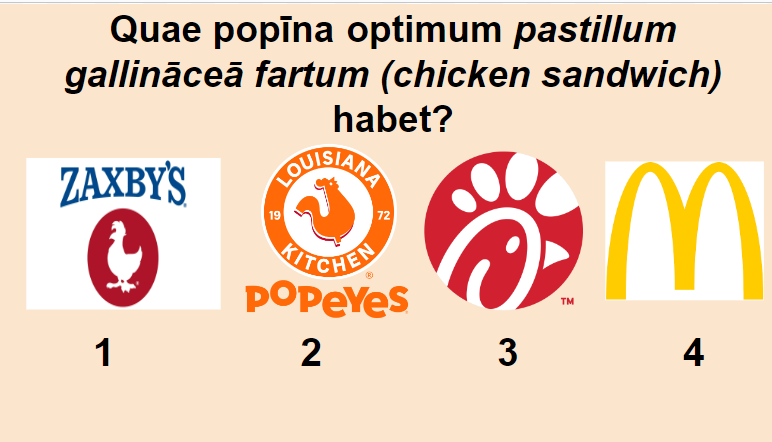
At the time in my Latin 2 classes, I had just given a purposefully communucative, cultural lesson in Latin about popinas (restaurants), so the next day, I decided to ask students a series of questions related to fast food restaurants in a "Four Corners" kind of way (where student would respond by moving to that corner of the room which corresponded to their answer). Each corner of the room was numbered accordingly, and I projected the first slide. 

After students moved to their corners, I would then ask invidual students opinion questions:  "tua sententia, estne Carlos rectus? Taco Bellne optimum cibum Mexicanum habet?" After asking this a few times about different students, I then revealed my pick: "mea sententia, Chipotle optimum cibum Mexicanum habet." Then I proceeded to the next question and repeated the process.

Observations

  1. I love these kinds of PQAs, because EVERY student has an opinion about fast food! I loved it that students would "argue" with each other and with me about which fast food restaurants had the best food!

  2. Students really wanted to hear my opinion on which fast food restaurant had the best X - maybe they wanted to learn about me, or maybe they wanted adult validation for their answers!

  3. I loved it when a particular corner would just have 1-2 students - I am glad that they felt safe enough to "voice" their opinion even if "unpopular." They were usually the ones whom I would ask the follow up opinion questions.

  4. Because this involved every student moving, students got to see others' responses (which is different from a traditional PQA where I may ask individual students or ask for a show of hands). 

  5. This activity definitely shows that purposeful communication does not always have to be verbal - we can still learn about ourselves and each other non-verbally. 

  6. As a teacher, I learned a lot about my students, even if it was just about their favorite fast food restaurants!

  7. This activity lasted about 10 minutes.

***************************************************************************************************************Anyhow, Eric and I would love to hear your experiences in the comment section - hope you can use these in your classrooms!

Wednesday, September 18, 2024

Is Circling/Asking Processing Questions Communicative?

This is a continuation in my series on purposeful communication.

So maybe you have been following my series about purposeful communication and are saying to yourself, "I implement Comprehensible Input (CI)/Acquisition Drive Instruction (ADI) in my classroom, so I am facilitating purposeful communication, right?" The answer is, "Well...it depends." CI/ADI in and of itself is not purposeful communication, nor is purposeful communication in and of itself CI/ADI. One can implement CI/ADI but not engage in purposeful communication, and one can facilitate purposeful communication but not implement CI/ADI.

What about circling/asking processing questions? Is that a form of purposeful communication? In circling/asking processing questions, am I not communicating with students?

As a backdrop, allow me again to quote Bill Van Patten's definition of communication and my previous explanation in an earlier blog post:

"Communication is the interpretation, expression, and/or negotiation of meaning for a purpose, in a given context." Based on that definition, Van Patten continues that our purpose should be that we wish to discover and learn information about each other, ourselves, and the world around us through communication, text, and input. In addition, in his book Van Patten adds that another purpose of communication is to entertain: "When we tell a joke or write a story...our purpose is to entertain in some way."

In his book, While We're On the Topic: BVP on Language, Acquisition, and Classroom Practice, Van Patten discusses that when we ask students questions, there are two types: display and context-embeddedAsking display questions IS NOT the same thing as being communicative. Here are examples of display questions:

  • Circling/asking processing questions - The purpose of this is not to learn anything new about someone or something. When circling/asking processing questions, one is purely verifying information which has been presented or the answer is obvious. This is NOT to say that circling/asking processing questions does not have its place in the classroom - Circling/asking processing questions helps determine comprehension while also allowing for more exposure to targeted vocabulary, but in and of itself, circling/asking processing questions is not being communicative. 
  • Asking questions for which one already knows the answer  - if I ask a student what color something is for which we can already see or know the answer, the very fact that it is obvious (such as the color of somebody's shirt, the color of something in a picture, the color of the sky), again asking that question is solely to verify information. As a class, we are not learning anything new about ourselves, each other, or the world. 
While display questions do have their place in a classroom, in general they do NOT equate to being communicative. Van Patten refers to this type of questioning simply as a way to "practice the language:"
Display questions are designed to elicit a specific response in order to demonstrate that the responder understands something and can respond with the (one and only one) correct answer.

I love this Bill Van Patten quote: "Just because mouths are moving does not mean a classroom event is communicative."

However, the opposite type of questions is context-embedded questions, those which are "designed to get information about a topic." Any time when you are asking students a question where you yourself do not know the answer by nature is a truly communicative event, since as a result, that response is teaching us "about ourselves, each other, or the world." In addition, a question where you need student response and input to help "create and to entertain in the language" is a communicative question. Examples of these types of questions are Personalized Questions and Answers (PQAs), StoryAsking questions, One Word Image questions, and opinion questions. 

The skill then lies in knowing how to incorporate both display questions and context-embedded questions, since they are both necessary and important in their own ways for language acquisition and communication. Here are some ways which I am learning to do this (emphasis on "learning"):

  • Circling/asking processing questions leading into a PQA - when circling/asking processing questions, can it seamlessly lead into a PQA? Example from a Clip Chat:
    • "The woman is eating dinner. What is the woman eating? (dinner). Yes, the woman is eating dinner. Is the woman making dinner or eating dinner? (eating dinner). Carol, what did you eat for dinner yesterday? Manny, what did you eat for dinner?"
  • Circling/asking processing questions leading into an opinion question - when circling/asking processing questions, can it seamlessly lead into an opinion question? Example from a Clip Chat (same scenario from above):

    •  "The woman is eating dinner. What is the woman eating? (dinner). Yes, the woman is eating dinner. Is the woman making dinner or eating dinner? (eating dinner). Class, in your opinion, is it a good dinner? (NOTE - she is eating pasta). Carol, in your opinion, is pasta a good dinner? Carol, in your opinion, what is a good dinner? In my opinion, a good dinner is _________." 
  • Circling/asking processing questions leading into a world fact of some kind - when circling/asking processing questions, can it seamlessly lead into a world fact which you can tie into the discussion? Example from a Clip Chat (same scenario from above):
    • "The woman is eating dinner. What is the woman eating? (dinner). Yes, the woman is eating dinner. Is the woman making dinner or eating dinner? (eating dinner). 80% of the world have rice or beans for dinner. Therefore, class, 80% of you should have eaten rice or beans for dinner yesterday. How many of you ate rice or beans for dinner yesterday?"
Again, I am stil learning how to do this. What has your experience been in springboarding into communicative-type questions from circling/asking processing questions?