Showing posts with label proficiency. Show all posts

Sunday, February 8, 2026

Freeze Frame as a Listening Proficiency Assessment

Want a quick summative way for students to demonstrate proficiency in their listening comprehension? Consider doing a take on the Freeze Frame activity! Because proficiency-based assessments test language modalities in an unrehearsed scenario, Freeze Frame is a great way to determine if students have aurally acquired language. I wrote about this activity in 2014, but I know that there are many others who use this activity too (if you have ever seen Eric Richards' presentation on whiteboard activities, he demonstrates this).

Freeze Frame is simply having students illustrate one giant picture which they hear you narrate in the target language. Students are not illustrating individual cartoon frames but drawing one picture, to which they add more details which they hear you narrate. (see blog post for an example of the picture and paragraph to read). 

Directions

  1. Using known vocabulary words and language structures, write a description in the target language of a single picture which you wish for them to draw. The more random the picture, the better! The description should be about 10-12 sentences.
  2. The paragraph needs to be something with which students are unfamiliar so that what they are hearing is unrehearsed - this preserves the proficiency and summative aspect of the assessment. Also, keep in mind that the paragraph must be 100% comprehensible to students, hence you are definitely recycling known vocabulary and structures but just not identical to a known passage. Having students work with a passage with which they are already familiar is performance in nature and reflects a formative assessment. 
  3. You can print up a sheet on which for students to draw or you can have them do it on their own sheets of paper.
  4. Explain to students that you are going to read a description to them, and their task is to draw a picture of what you read to them.
  5. Read the paragraph in "chunks," i.e., parts of the picture at a time. 
  6. As students hear you read the "chunks," they are to illustrate what you say. Repeat the sentences MANY times!
  7. Since this is a proficiency-based listening assessment, grade according to a rubric. Below is an example of one which I modified/adapted. I found this on Elicia Cardenas' blog The Deskless Classroom.

Observations
  1. Wow, this was a fast assessment. It took about 10 minutes to administer!
  2. Grading according to a proficiency-based rubric like the one above made it so easy and quick to grade. 
  3. I would advise doing some practice with this kind of activity first before using it as an assessment so that students understand that they are drawing one giant picture and that you are giving them parts of the picture to draw a few sentences at a time.
  4. The repetition of the sentences as they draw allows students to hear continued exposure of understandable messages.
Give this a try as a summative listening comprehension assessment!

Saturday, November 8, 2025

Guided Choice Writing

As I have posted earlier, I am teaching Latin 1 again and am doing things much differently than I have in the past. So much of this is due to my own increased understanding of what is considered realistic language proficiency at this level (Novice Lowish) and that in many ways in the past, my own expectations of student proficiency for Latin 1 were wrong. I have focused on sheltering vocabulary BIG TIME, targeting high frequency words, with the intent of going "deep and simple" and not "shallow and complex."

As a result, when it has come to writing, I have been experimenting with students doing "guided writes" instead of doing timed writes. In a "guided write," like the name states, I am guiding students through what I want them to write for the creation of a story, since they are novice low writers. There is a degree of student choice where they can add their own details, but I tell them EXACTLY what they are to write for each sentence based on a word bank. I am also only focusing on words which we have been targeting. Below are some examples from throughout the semester:

Week 6


Week 10

Week 14

Student examples


Observations
  1. If you take a look at the three examples, you can see that I keep adding more details or focus on different aspects as the semester progresses. In the last example, you can see that the focus is on creating guided longer, compound sentences using and and because.
  2. I like the guided aspect, because for these novice-low students, I do not think that they are ready to just "write" without very specific parameters
  3. In many ways, the sentences are like those in Rotating Desks where I am telling students what to write and that they have choice in adding details.
  4. This is a form of purposeful communication on a low level, since students are playing around with the language by choosing their own details to add. 
  5. Will students' grammar be correct? Most likely, no! BUT I also have NO expectations of it to be, since they are novice low learners. I am only interested in "Are they communicating in a way which I as a sympathetic receptor can understand?" I cannot tell you HOW FREEING that perspective is as a teacher!
  6. Even though I am telling students what to write, hopefully as they write these sentences, students are understanding those messages which they are writing. Thus, this is adding to/refining their mental representation of the language. 
  7. This is a precursor to the 4-Word Story writing activity which I will introduce to them next semester. By then, these students should have a foundation where they can write more freely on their own.
Have you done something like this? If not, give it a try, and let me know how it goes!

Sunday, October 5, 2025

Novice Picture Writing Proficiency Assessment w/ Rubric

I am trying out something new with writing in my Latin 1 classes. In previous years when I taught Latin 1, I had students doing timed writes after the first week based on readings/clipchats, but big picture, I never felt comfortable with that, because I felt like all students were doing was spitting back to me memorized sentences from the story, not necessarily any true acquired language. Since they have only had 8.5 weeks of Latin so far this year, they are "babies" when it comes to writing in the target language.

As a result, this year in my Latin 1 classes, I have been holding back on writing in Latin per se (outside of copying sentences from readings in lots of various activities or doing very guided writing. NOTE - these types of writing in the target language still have MUCH value!) so that I am not forcing output too quickly and have chosen instead rather to focusing on bathing them with sheltered vocabulary input before any true output.

After 8.5 weeks of Latin, I gave students their first written proficiency assessment based on a series of pictures which created a story (AI created the pictures). Although students had never seen the pictures before, they did mirror many of the sentences which had been in readings and also in bellringers. The difference, however, was that they had never written this many sentences before in Latin at once in one sitting and never in a sequence for the creation of a story. 

I gave them six pictures, of which there were at least 3-4 sentences which they could write for each of them. HOWEVER, I only asked them for 1-2 sentences for each picture. I debated about this:
  • I knew that there would be some students who could only write one short, choppy sentence per picture.
  • I also knew that there were many students who were already writing compound sentences using "and" or "because," so in writing one compound sentence, they were already demonstrating proficiency beyond the expectation.
  • I was grading this on a rubric, so the minimum number of sentences was not the sole criteria but rather were they also adding details, combining details, etc in the picture?
Below is an example of one of the pictures used (I made two others):

Observations
  1. Wow, I was absolutely amazed at what students wrote and how much they wrote! It was like after bathing them in so much input for the past 8.5 weeks that it overflowed similar to turning on a faucet - it all finally came out!
  2. Student examples from picture 1 (in Latin and English):
    1. Puer Marcus. Puer Julius. (The boy Marcus. The boy Julius).
    2. Puer est Marcus. Marcus est parvus. (The boy is Marcus. Marcus is small).
    3. Marcus est parvus. Julius est magnus (Marcus is small. Julius is big).
    4. Marcus est parvus puer, et Julius est magnus puer. (Marcus is a small boy, and Julius is a big boy).
    5. Hic est puer. Ei nomen est Marcus. Marcus est parvus et laetus puer. Hic est magnus puer. Ei nomen est Julius, et is est laetus. (This is a boy. His name is Marcus. Marcus is a small and happy boy. This is a big boy. His name is Julius, and he is happy).
  3. It was so weird to see the Theory of Ordered Development occurring in their output right before my eyes. A number of students left out the Latin word "is" when trying to write "the boy is big" and instead wrote "the boy big." Before, I would have been frustrated over this and would have blamed the students, but knowing now the Theory of Ordered Development, I was like "Yay, you're proceeding along EXACTLY as you should be!"
  4. Grading on a novice-low writing rubric informed by ACTFL Proficiency Guidelines made it so much easier! Because I was not focusing on errors and performance but rather on "show me what you can do and where you fall on the proficiency continuum/spectrum," this freed me greatly!
  5. Yes, there were spelling and grammar errors - LOTS of them! However, when grammar errors are the norm and expectation since these students are novice learners, I only marked those errors if they impeded my understanding of their messages (even me as the "sympathetic receptor") which lowered their placement on the rubric.
  6. I was surprised by how many students used vocabulary which I had not been truly targeting yet or for which I had not yet held them accountable. However, I had been using these words but usually they were glossed for bellringers, reading passages, and listening. Somehow, these students had already acquired those words, and those words were inside of them ready to come out!
I plan to do more of these kinds of writings!

Monday, September 29, 2025

New Page on my Blog - Proficiency-Based Grading

There is a new page on my blog - Proficiency-Based Grading. It is now listed at the top in the navigation bar. I hope that you will find the information useful.

Proficiency-Based Grading 

Monday, September 22, 2025

Performance vs. Proficiency

I am now in week 8 of school - I cannot believe that I have been with students for almost two months! One of my goals for this year has been to fully implement a proficiency-based grading system. While I have dabbled with the concept in the past few years, this year I wish to fully commit to it.

However, when discussing proficiency-based grading with others, I have come to realize that there are lots of different views about this, of which many are incorrect. Much of this comes down to one's understanding of performance vs. proficiency. I will admit that I did not learn about this concept until a few years ago, and now having an understanding of it has completely transformed the way I view grading. 

So allow me this excursus to distinguish between the two in a language classroom - none of the following information is mine but comes from years of learning about the topic from Martina Bex, Elicia Cardenas, and many others:

Performance

  • “spit back what you know," rehearsed
  • should be formative in nature when employed, informs teacher of where the knowledge gaps are and what gaps need to be filled
  • focuses on errors made
  • results tend to be quantifiable in nature, follows the "start from 100 and deduct errors" model
  • rubric/traditional number grading
Proficiency 
  • unrehearsed, real world
  • "show me what you CAN do!"
  • should be summative in nature
  • holistic grading - "where do you fall on the rubric/continuum based on exemplars?"
  • rubric (possibly based on ACTFL guidelines)
So when assessing the different modalities of a language classroom, what do formatives vs. summatives, performance vs. proficiency look like?

Reading (When assessing reading, always ask questions in commonly shared classroom language (probably English) and have students respond in that language. See Martina Bex’s blog post - “Reading Activity or Reading Assessment” for explanation).

  • Performance
    • formative
    • answer questions about a KNOWN reading with which students are already familiar. Again, the "spit back what you know" model.
  • Proficiency
    • summative
    • answer questions about a SIGHT reading but based on KNOWN vocabulary and structures. This will inform you as the teacher if/what students have acquired.

Listening

  • Performance
    • formative
    • examples: which picture (A or B) am I describing?; draw what I say from a known story; which character from the story am I describing in the target language?
  • Proficiency
    • summative
    • examples: based on KNOWN vocabulary, draw these unfamiliar sentences which I say; write the correct target language response to what I am saying.

Writing

  • Performance
    • formative
    • example: timed write where students retell a KNOWN story in the target language, write a guided story using known vocabulary; write 4-5 sentences about what you see in the picture.
  • Proficiency
    • summative
    • free write examples: change a detail in the story and write about it; write a sequel/prequel to the story; write about a parallel character; write a story about what you see in the picture.
Speaking

If possible, avoid speaking assessments in the first two years (due to output theory)

Grading rubric examples

Friday, May 9, 2025

What Does Latin 2 Look Like?

Not too long ago, I was speaking with a Latin teacher about novellas, and he asked, "So what does a Latin 2 novella look like?" While a simple question, it is actually MUCH bigger than a simple answer for a number of reasons - the bigger question is what does Latin 2 look like?:

  • There is what textbooks say. Textbooks are not written with second language acquisition theory in mind, because namely, they further the misinformed concept that language learning is linear in nature. Textbooks will introduce a chapter on a particular grammar concept, with the "introduced on Monday and mastered by Friday, and ready to move on to the next concept" model. Because of this, there are particular grammar concepts which we tend to think of as "higher level," because textbook have "told us" that they are, e.g., subjunctives, gerunds, gerundive, sequence of tenses, etc. Big picture, however, novice learners can use these concepts quite early - we just tend to think that they cannot and are not ready for them!
  • There is what the National Latin Exam syllabus says a Latin 2 class should cover (which is basically a rehash of what grammar-translation textbooks say).
  • There is what traditional grammar-translation Latin expectations say, namely that by the end of Latin 2, students should be able to translate Caesar. As a result, teachers should have covered ALL necessary grammatical concepts

HOWEVER, regardless of what textbooks and tradition may say, language levels are NOT determined by grammatical constructions, vocabulary, or cultural topics. ACTFL defines language levels by proficiency, where the primary difference between profiency levels lies in the complexity of tasks and the amount of language in which an individual can perform them. 

Most CI/ADI teachers who use ACTFL standards-based grading define the anticipated target proficiency levels for language levels as follows - ACTFL Proficiency Guidelines - 2024 :

  • Level 1 - Novice Mid
  • Level 2 - Novice High
  • Level 3 - Intermediate Low
  • Level 4 - Intermediate Low (note that level 4 is still considered Intermediate Low, since the Intermediate level is considered a much wider range of proficiency compared to the Novice levels)

Nowhere in the ACTFL proficiency descriptions is grammatical acuracy mentioned as an exemplar of a Novice or Intermediate learner. In fact, the expectation is that these learners will make LOTS of grammatical errors when communicating! ACTFL guidelines state that communicators at these levels can be understood by sympathetic receptors who are accustomed to non-native communicators.

So to return to the original question of "What does a Latin 2 novella look like?", here is what ACTFL says regarding reading proficiency at the Novice High level:

At the Novice High sublevel, readers can understand, fully and with relative ease, key words and cognates, as well as formulaic phrases across a range of highly contextualized texts. Where vocabulary has been rehearsed, they can understand predictable language and messages...

Based on this, a Latin 2 novella would continue to employ formulaic sentences and predictable language and messages (as found in previous Novice Mid readings), but the assumption is that now there is a greater foundation of vocabulary and of grammatical constructions from which to draw. Again, let me say: TOO MANY LATIN NOVELLAS ARE WRITTEN WITH A TEXTBOOK MODEL IN MIND! Latin textbook readings are not written based on ACTFL proficiency guidelines and are overly complex in terms of sentence length and too much vocabulary for the specific levels. Keep in mind that "complex" grammar structures can indeed be introduced in the novice levels - just be sure to use them over and over again so that they are formulaic and predictable in nature! This is not "dumbing down" or removing "rigor" from reading Latin - rather, this is aligning L2 reading with realistic expectations and second langauge acquisition! I love introducing "cum clauses + pluperfect subjunctive" very early in Latin 2 readings and using them over and over again so that students become very familiar with them. 

Monday, January 30, 2023

Output is Messy

As I continue to direct my classroom towards a proficiency-based curriculum and one based on acquisition-driven instruction, I am amazed by what students are able to output purely based on what has been input. However, at the same time, so often that output is strewn with grammatical errors, while some students still have difficulty "outputting." When I see students struggle with either oral or written output, as their teacher I have to ask myself some questions:

  • Have they not received enough of the correct kind of input? In other words, while I may have provided students with understandable input, was the input WAY too overwhelming and too much for them to handle? Just because the input itself was understood does not mean that students were able to handle all of that intake. 
  • Was my input even comprehended? While I may have delivered what I deemed to be understandable, was it really?
However, the biggest question which I must ask myself, "Is what I am seeing COMPLETELY NORMAL for language learners in their proficiency journey, so therefore it is I who must be the one to change and to manage my current expectations?"

In many ways we can get a false sense of mastery of output demonstrated by novice-level students, since so often their communication is based solely on an exchange of memorized life skill phrases (greetings interaction, memorized dialogues, etc.). Students seem to progress so quickly through novice-level language proficiency, but then it seems like they hit a wall when it comes to intermediate-level communication. Although there is a higher-level of expectation for these learners since it seems like they should be able to do more with the language, their output is strewn with errors!

I once heard Ariene Borutski, a CI French teacher in Southern California, say that according to one of her professors, "proficiency is communicating using what you know." I really like that definition, because now that I understand more about language proficiency and the ACTFL levels, it makes perfect sense! If you were to take a look at the ACTFL proficiency guidelines, you would see the various indicators which exemplify each level. However, the proficiency guidelines NEVER address grammatical errors (either the amount of or lack thereof) as indicating language proficiency. Grammatical errors at the novice and intermediate levels only matter when they impede meaning for a sympathetic listener/reader (an ACTFL term). In most instances, novice/intermediate level students are indeed using what they know (i.e., their mental representation of language) which probably has A LOT of holes and gaps which need to be filled. Although we may wish to speed up the process of filling those holes and gaps, according to second language acquisition research, no amount of explicit instruction and correction will remedy it. It will happen when it happens.

Intermediate-level communication of any kind is MESSY. While a student at the intermediate level may have been exposed to more language than a novice and therefore be able to wield more language output, this student probably does not possess the language control of an advanced learner. So when I hear a student say "mihi vult comedit Takis," that sentence is SO FULL of errors (instead of "volo comedere Takis"). However, when I take a step back and realize: a) that this is an intermediate level student and b) this student is using/applying what is "known" at that moment (i.e., whether it be right or wrong, this is what the student's mental representation of language is) and c) errors are the norm at this level and d) as a sympathetic listener, I am still able to understand what this student is communicating, then I realize the following: 


It also shows me where the holes and gaps are in students' mental representation of language and where to focus continued input. 

So when I go in with an expectation that Intermediate-level communication is going to be messy and probably laden with errors, it is a realistic view of language proficiency. This is not to say that standards are being lowered and watered down - far from it! Instead, our expectations were way too high to begin with and did not reflect true reality! As an Intermediate-High Latin speaker, I am so glad to know this, because for me, it is absolutely freeing to realize ahead of time that I am going to make mistakes, because it is expected! 

Monday, August 1, 2022

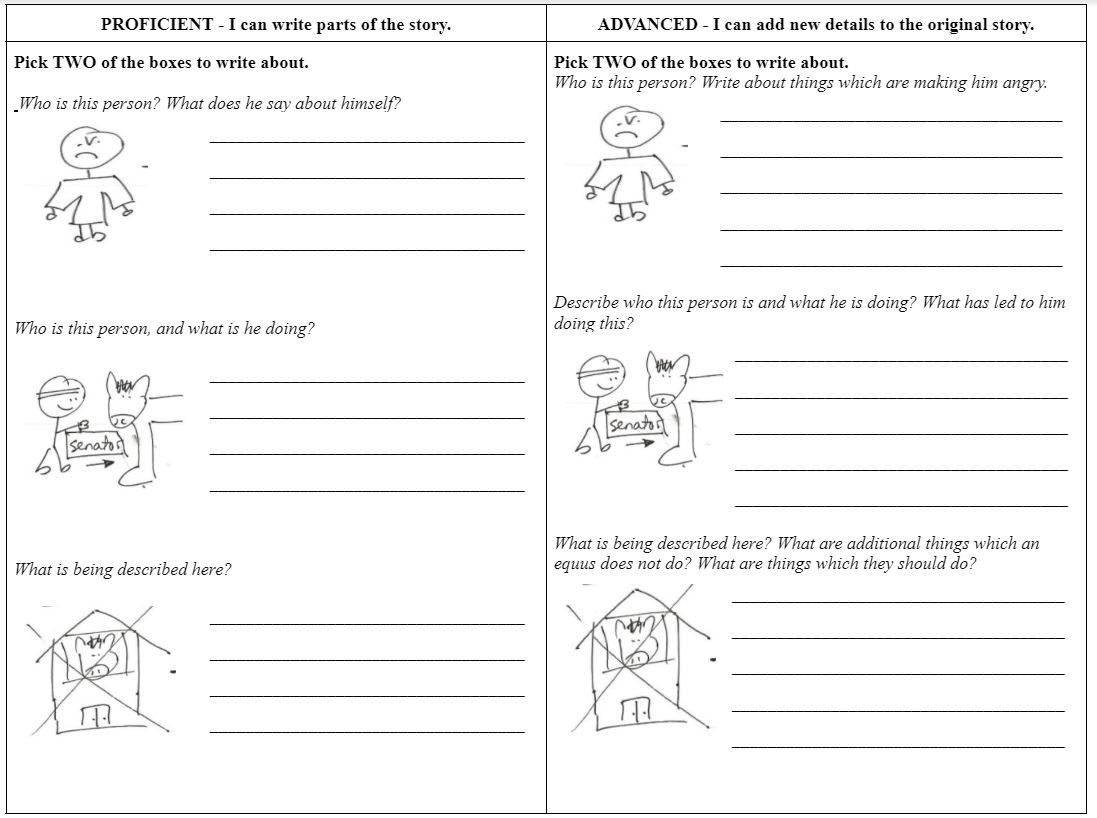
"I Can" Writing Proficiency Check-ins

This is a type of writing check-in/assessment which I have learned while serving as a coach for Martina Bex and Elicia Cardenas' Acquisition Boot Camp (which by the way is a GREAT course for those wanting to learn more about CI/ADI instruction). I am not going to spend time here describing this type of assessment, because Martina does such a good job of this in her blog. Essentially it is a writing check-in/assessment over a current reading where students can choose at which level of writing proficiency with which they are most comfortable for that particular reading. However, to use this type of assessment, a teacher truly must have a good understanding of language proficiency. With what degree of language control are students able to communicate? Words? Simple sentences? Create new language?

Whenever it comes to language output with novice and intermediate language learners, we as teachers need to expect errors (and lots of them!). We need to realize that grammatical mistakes and shaky language control are typical in these proficiency levels; therefore, they are expected and okay! As a result, we need to focus on what it is that students are able to communicate and what we as sympathetic receptors can understand from their messages.

Observations
  1. I absolutely love this how this is set up - thanks, Martina!
  2. I view this type of "assessment" as merely a check-in for students to let me know where they are with the material - what have they acquired so far with the new material? Where are they with language output? Simply, it is a snapshot of their proficiency at the moment, and the snapshot is neither good nor bad. It is simply to inform me (and hopefully students) of where they are at. 
  3. Personally, I do not grade these, but I definitely do look at them. If you look at Martina's original directions, you will see how she grades these according to a proficiency-based rubric.
  4. I like the choice aspect of this, because it gives students permission to proceed at their preferred level of comfort when it comes to written output. Also, within each level, there is a degree of choice so that students can choose those options which will best display their mastery. 

Monday, February 22, 2021

More Observations about Student Grammar Errors

This semester, I am focusing on having students do free writes for their writings. Previously during a normal face-to-face teaching setting, I would have students retell the particular story in Latin which we had been going over for that unit by writing it down in a composition book. Since we had reviewed the story so much as input, writing would be a natural way for output to occur. However, in this digital setting and having students type out their writings of the stories on a Google Document, I soon found that many students were just copying and pasting from digital copies of the story which were already on Google Classroom from previous assignments and submitting that as their writings. As a result, I decided to focus on free writes, where I give students a prompt for them to complete, and their job is create a sequel to the story on their own from that prompt.

Here are some examples of Latin 3 student writing based on the prompt which my colleague John Foulk created: Monstrum et puer nunc sunt amīcī. Cum monstrum et puer aquae appropinquant, subitō…

Example 1

Monstrum gaudet. Monstrum est laetus. Monstrum est lateus qoud amici habet. Monstrum numcam habet amici. Monstrum non queritur dentes e ocolus. Subitio de aquae Peppa pig surgit. Peppa vult cibum. Peppa dicit “puer dat cibum NUNC!” Puer timet. Monstum non placet Peppa.Puer est eius amici, non vult puer timit sed vult puer lateus. Monstrum petit Peppa. Peppa  pettit monstrum. Petit e petit e petit Subito Peppa cadit in Aquea et perit. Puer est lateus sed non iam timet. Peur est latues quod oculous habet et puer potest videre monstrum est un amici.Monstrum et Puer ambulat ad tabernam. Subito Peppa surgit et didct “redibo”. “Non iam pax in gens sed bellum, bellum gerit contra puer et monstrum.”


Example 2

Puer cadit in aquae. Puer non potest natare. Puer est patitur. Monstrum nonscivit liberate puer. Monstrum parat videt mortuus est puer. Monstrum est tristis et patitur, videt drowning puer. Monstrum tristissimus et fugit ex from aquae. Monstrum in dolore et searches for miles ut liberate puer. Monstrum et miles fugit ad puer, sed puer non iam in aquae. Iam puer cum piratae. Piratae liberavit puer et nunc puer est piratae. Pirataes non placet monstrum. Pirataes bellum gerit monstrum. Sed Monstrum fortissimus. Monstrum caedet pirataes et pirataes nunc mortuom. Monstrum vicit pirataes et nunc odit puer. Puer est vulneratus et non iam placet Monstrum. Puer odit Monstrum. Puer fugit ab ex monstrum. Puer videt aliud monstrum sed non amici est. Nunc Puer odit et ab fugit omnes monstrum.


Example 3

Imperator appropinquant. Imperator fortis et audax. Imperator habet arma et vult bellum gerit. Imperator of Bikini Bottom ingens et cancer. Monstrum et puer timet. Monstrum et puer vult pax, non vult proelio. Monstrum iubet ut pax. Imperator iratus et non vult pax. Imperator cadit in terra. Imperator manet in terra. Imperator patitur sed imperator vulneteratus. Imperator non iam vult bellum gerrit. Monstrum, puer, et imperator nunc sunt amici. Subito, regina Sandy appropinquant. Sandy considit in terra, Bikini Bottom. Monstrum, puer, et imperator considit in terra. Imperator audit Patrick et SpongeBob mortus. Imperator iratus et non lauetus. Imperator in dolore. Monstrum et puer in dolore. Omnes Bikini Bottom patitur. Pauci homines such as Squidward non patitur et guadit. Squidward laetus et canit carmen. Monstrum, imperator, puer, et Sandy non nunc sunt amici with Squidward. Omnes iratus at Squidward. Imperator et Sandy videt taberna. Imperator, Sandy, monstrum, et puer vult comedere.


Now if you are familiar with Latin, the first thing which I am sure that stands out to you is the SHEER AMOUNT of grammar and spelling errors! And I am certain that for many of you, it is very PAINFUL to read. However, if I view these writings through the lens of a sympathetic reader (an ACTFL term), then wow, these students are communicating in the language! Even though these are Latin 3 students, in terms of language acquisition, knowledge, and grammar control, they are novice-high/intermediate-low writers. If my students were children learning their first language, they would be equivalent to 2-3 year-olds. As a result, their language is going to be incredibly MESSY! To use an example from Bill Van Patten, when a 2-year old says, "Mommy go bye-bye," do you correct that child's grammar and choice of vocabulary? Absolutely not, because you as a sympathetic listener know exactly what that child is attempting to communicate. That child is piecing together whatever vocabulary has been acquired to communicate. You can try to correct that child, but we know that the child's language will improve over time with more input and exposure.

I have used this illustration before, but it is so true!


Why can I relate to the above illustraion? Because the first time I truly spoke Latin in 2010 at Rusticatio, a weeklong immersion event, everything that came out of my mouth was in the nominative case and in infintives. Keep in mind, I have my Masters in Latin, but when it came to truly speaking in Latin for the purpose of communication and conversation (something which I had never done before), I was a novice - a very LOW novice. My grammar was horrible! Case endings, verb endings, and subject/verb agreement went out the window, because all i could do was just get vocabuary to come out of my mouth - any vocabulary!! 

I love Nancy Llewellyn's quote which she traditionally gave in her opening talk at Rusticatio:

You are going to make the same kinds of grammar errors that if your own students were to make them, you would skin your knees running to grab a red pen to correct them. So be patient with yourself.

That was ten years ago. I can say that I am probably an Intermediate High level speaker now, but I still definitely struggle trying to put it all together with correct case endings, subject/verb agreement, correct usage of subjunctives, noun/adjective agreeement, pronunication, etc.

So when getting students to write in the target language, be sure that there has been plenty of input first so that there is a natural overflow of output, but be prepared for it to be messy. However, if you are viewing the output from a proficiency viewpoint instead of a performance lens, you will be amazed by what students are attempting to communicate in the language.

Thursday, March 9, 2017

Writing from Novice Learners

This semester, I have been doing a number of free writes in my Latin 1 classes. Though I still implement timed writes (which to me is usually attempting to re-tell a story in the target language which we have been going over in class), I have also been giving opportunities for students to write whatever they want in Latin based on input.

As writing is an output activity, it is important that we bathe students in input to such a degree that output is a natural overflow of that input. This is why I like implementing timed writes - after going over a story 6-7 different ways over 3-4 days, all of that input from that story has somewhere to go as output. Free writes, however, are different. To me, free writes are exactly that: students have the chance to create and to write freely whatever they want in the target language and are not spitting back a story. I usually give them a prompt of some kind and then let them write for X amount of time.

Having students do free writes has been a very interesting experience so far, and I am learning SO much about language acquisition theory in the process, especially for novice learners.

Observations
  1. As not every student acquires language at the same rate, I have to accept that students "will be all over the spectrum" when it comes to output. There are students whose extent of writing output is being able to re-combine a seen list of vocabulary to create sentences, while others are able to create and to fashion sentences on their own. Guess what? Each of those examples is perfectly fine. The important thing to remember is that every individual student is exactly at the point where he/she is at; I cannot force students to progress at my pace. My sole job is to continue to immerse my students in understandable messages to aid them along their individual output continuum.
  2. Output is going to be MESSY!! Messy to me, that is. To the student, however, most likely they are completely unaware of their errors, which is fine, because that is where they are at in their language acquisition. I love the following cartoon:
  3. I am surprised at the number of students who are writing compound sentences on their own. In many ways, I do not think that they realize that this is actually "complex," because they are constantly hearing and reading compound sentences in the target language. In many ways, they cannot help but write compound sentences due to vast amount of input examples.
Some examples of free-write activities