Showing posts with label assessment. Show all posts

Monday, August 1, 2022

"I Can" Writing Proficiency Check-ins

This is a type of writing check-in/assessment which I have learned while serving as a coach for Martina Bex and Elicia Cardenas' Acquisition Boot Camp (which by the way is a GREAT course for those wanting to learn more about CI/ADI instruction). I am not going to spend time here describing this type of assessment, because Martina does such a good job of this in her blog. Essentially it is a writing check-in/assessment over a current reading where students can choose at which level of writing proficiency with which they are most comfortable for that particular reading. However, to use this type of assessment, a teacher truly must have a good understanding of language proficiency. With what degree of language control are students able to communicate? Words? Simple sentences? Create new language?

Whenever it comes to language output with novice and intermediate language learners, we as teachers need to expect errors (and lots of them!). We need to realize that grammatical mistakes and shaky language control are typical in these proficiency levels; therefore, they are expected and okay! As a result, we need to focus on what it is that students are able to communicate and what we as sympathetic receptors can understand from their messages.

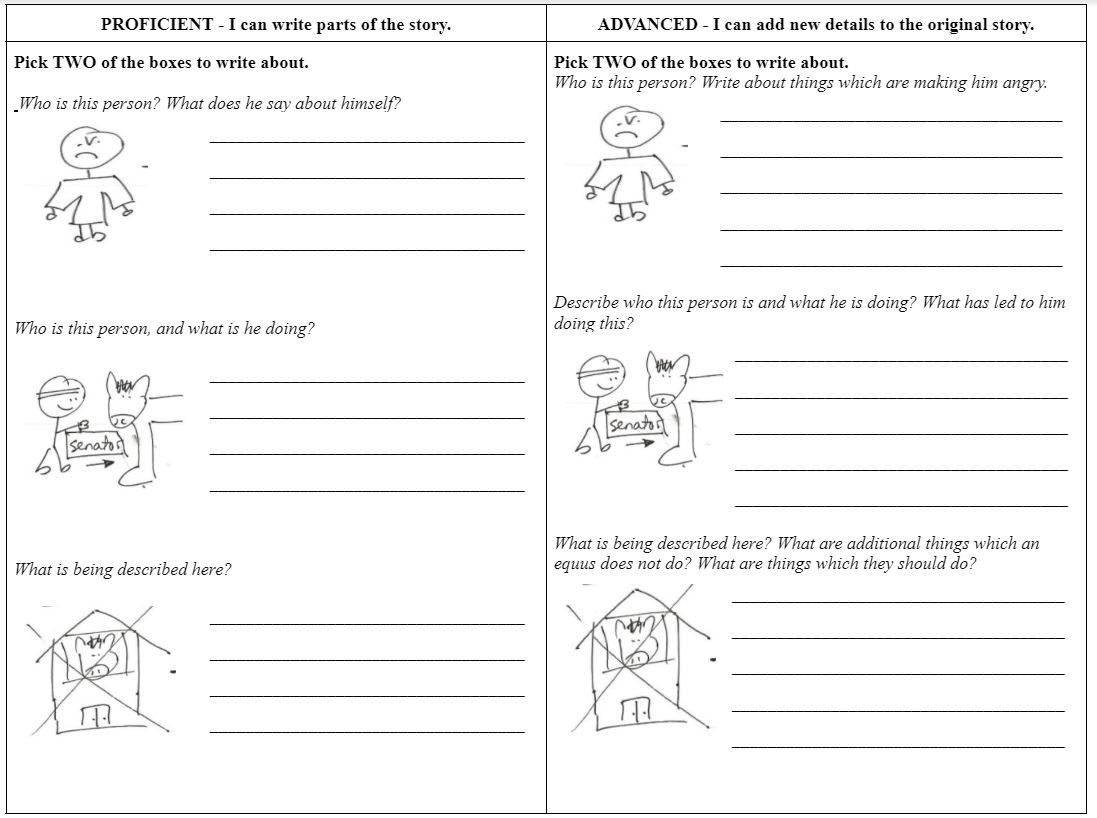
Observations
  1. I absolutely love this how this is set up - thanks, Martina!
  2. I view this type of "assessment" as merely a check-in for students to let me know where they are with the material - what have they acquired so far with the new material? Where are they with language output? Simply, it is a snapshot of their proficiency at the moment, and the snapshot is neither good nor bad. It is simply to inform me (and hopefully students) of where they are at. 
  3. Personally, I do not grade these, but I definitely do look at them. If you look at Martina's original directions, you will see how she grades these according to a proficiency-based rubric.
  4. I like the choice aspect of this, because it gives students permission to proceed at their preferred level of comfort when it comes to written output. Also, within each level, there is a degree of choice so that students can choose those options which will best display their mastery. 

Monday, November 15, 2021

Picture A/Picture B Listening Assessment

Who says that assessments must be long?!! Here is a very low-key, very quick listening comprehension assessment which I learned this past summer from Martina Bex and Elicia Cardenas while working as a coach for their Acquisition Boot Camp (ABC), and it is very simple for you as the teacher to administer. Simply, you either project two pictures onto a screen or put them on a piece of paper - these pictures are labeled A and B. You read a target sentence aloud, and you ask students to determine if the sentence is describing picture A or picture B. As a teacher, however, it requires a bit of prep work.

Pre-Assessment

  1. Taking a story which you have been going over in class, select 7-10 sentences. If it is from a movie talk, you could use screen shots.
  2. Illustrate those sentences. 
  3. Scan them (or use a web app drawing tool) or illustrate them onto the assessment paper.
  4. Place the scanned pictures in pairs onto Google Slides for projection or onto a document. 
  5. Label one picture "A" and the other picture "B"
  6. For each pair, determine which sentence you read will read in order to match up with the correct picture.

Assessment
  1. Explain to students that you are going to read aloud a sentence from the story, and their job is to determine if the sentence being read is Picture A or Picture B. I project the pictures on Google Slides and have students on a sheet of paper number 1-10ish, and they simply answer A or B.
  2. Read the sentence a couple times slowly and then move onto the next set of pictures.
Observations
  1. Oh my gosh, why did I not learn about this assessment earlier?? It is so easy and quick to administer (although it takes some type to prepare it) - it took less then five minutes to administer. Students simply had to write down either A or B on their paper. If the pictures are on a sheet of paper for them, they simply have to mark the picture being described.
  2. I used this as a formative assessment and not as a summative assessment. 
  3. These were incredibly easy to grade too, because I was simply looking for either the letters A or B as the answer.
  4. Students liked this assessment, because it was fast and easy for them to complete.
  5. When picking pairs of pictures, select pairs which require a close listening and inspection of the pictures. In the example above, each of the pictures involved the phrase "duo comites (two comrades)" so students had to listen carefully to the rest of the sentence to determine what distinguished the two pictures. In other words, I could not have one picture have two people in them and the other picture being of a dog, because when students heard the phrase "duo comites," immediately they would know which picture it was and would not listen to the rest of the sentence. 
  6. The picture being described needs to be OBVIOUS for students.

Friday, July 31, 2020

GoFormative - Get a Taste!

I have been playing around with Formative, which is an online assessment tool. When we had to switch abruptly to online teaching, I heavily used self-grading Google Forms for various ways of assessing students (and have written here about those uses). However, now that I have learned about GoFormative and as I am beginning the school year again in a digital environment, I am going to be using this web app tool, as well as Google Forms. 


I will post more about Formative here on this blog, how to use it in conjunction with Google Classroom, and how I plan to use its various functions in a classroom setting, but if you wish to experience it yourself as a student, here is a quiz which I just made as I was playing around with it. The majority of the quiz is Latin, but if you do not know Latin, you can at least see the various ways of assessing students. 

Go to goformative.com/join
Code: 6J845M


Formative is not free, but I used the 30-day free trial to create this formative assessment.

Wednesday, November 1, 2017

"Who is This" Assessment

This is a quick assessment idea which I learned from my colleague Bob Patrick. Recently, our Latin 2 students were finishing up a story, so Bob implemented this listening assessment involving characters from the story with his class, which in turn, I used with my students. If your class is reading a story with at least three characters who do a number of different things, then this is a great way to assess students.

Planning
  1. In the target language, create a number of sentences that describe different characters in the story. I have found that 8-10 sentences is a good number.
  2. Each sentence should start out with "this character" (in Latin, haec persona) - I used actual sentences from the story since those sentences were with what students were most familiar.
Implementation
  1. Write the character choices on the board.
  2. On a sheet of paper, have students number 1-8 (or however many sentences you have created.
  3. Explain to students that for each of the sentences which you will read aloud, their job is to determine which character this sentence describes and to write down that character.
  4. Read each sentence 2-3 times very slowly, as students write down the character about whom the sentence describes.
  5. At the end, read each sentence again so that students can check their responses. 
Latin Example - this was based on a story from a Movie Talk (Broken: Rock, Paper, Scissors)

a) forfex             b) puella chartacea          c) saxum

Question #1 - haec persona credit puellam chartaceam esse pulchram.
Question #2 - haec persona occidit multas arbores.
Question #3 - haec persona vult fugere cum puella chartacea.
Question #4 - haec persona occidit puellam chartaceam.
Question #5 - haec persona magnos sonos facit.
Question #6 - haec persona non vult fugere cum saxo.
Question #7 - haec persona occidit forficem.
Question #8 - haec persona fugit cum saxo.

Observations
  1. This was indeed a very quick assessment - it took less than 10 minutes.
  2. This is a great activity to assess listening comprehension in a very low-key way.
  3. I was surprised at how well my students did on this. You need to understand that when I was learning Latin in high school and in my college and graduate courses in Latin, I NEVER heard it spoken. Because I am implementing Comprehensible Input in my Latin classes with lots of repetitions in active Latin, for my students to hear Latin does not seem that big of a deal for them.
  4. Afterwards I asked students what they thought of it. A common response - "It was really easy, since we have gone over the story so many times..."