In trying to pre-teach vocabulary for the 2nd chapter of Brando Brown Canem Vult, I wanted to do a Movie Talk which incorporated the words birthday, birthday party, bring, gift/present. Quite honestly, I could find NOTHING on the Movie Talk database relating to these words. I was shocked, because I thought for sure that there would be an animated short about a children's birthday party.
On Vimeo, I did, however, come across this animated short called The Present (I have now added it to the Movie Talk database). Although it does not have a birthday party in it, I could pre-teach words like gift and brings. It is only about 3 1/2 minutes, but wow, it is really good! At IFLT this past summer, Katya Paukova said that the best movie talks are those which engage the emotions - I saw Katya demonstrate one involving a one-minute Budweiser commercial which totally drew me in due to its emotional content. The Present is definitely one which will hold students' attention (much like Bear Story, although my students have made me swear never to show anything that sad again!).
Below are scripts in Latin and in English. Hope you can find them useful!
English script
Latin script.
Observations
1) Even though The Present is only 3 1/2 minutes, it allows for lots of repetitions and some great opportunities for circling. I was able to get a lot out of this movie short.
2) Stop at 2:33, and then go back to the beginning to watch it again all the way through uninterrupted. I did not want to ruin the impact of the ending with me interspersing circling questions.
3) I actually had a number of students show this movie short to their parents that evening!
Wednesday, November 16, 2016

Saturday, November 12, 2016
This Time of the Year
I have a confession to make: at this very moment, I am having a love/hate relationship with teaching, and unfortunately, the "hate" part seems to be winning. For the past 6 weeks or so, I have found myself absolutely questioning why I am still a teacher in the classroom. I feel like teaching has turned into a laborious and toilsome effort for me. I feel like I have been faithfully applying CI in my classroom, but I also feel like I am "teaching the walls" on many days, as students do not seem to respond as they did before - has the novelty of me and of a CI classroom worn off for them? Am I now just viewed as a tremendous joke in the eyes of my students? Even though I know for a fact that students have acquired a great deal of Latin after just 14 weeks, am I moving too slowly? Have they acquired too little? Am I actually doing them a disservice? Am I an effective teacher at all? As a result of all of this, now that I have completed my Ed.S degree and am certified in Instructional Technology, the thought of leaving the Latin classroom to become a school technology coordinator or an instructional coach has become a more tangible, tempting possible pursuit.
In light of all of this though, here is what I know to be true: I always feel EXACTLY this very way about teaching at EXACTLY this time of the year EVERY year. And EVERY year, I get through it.
In other words, when I take a step back from it all, what I am feeling is absolutely normal and part of the teaching experience. It is part of being human. That is actually very encouraging, i.e., it is not I per se who is the problem - it is just par for the course of teaching. As a teacher, I absolutely hate this time of the year. As school begins the second week of August here in Georgia, we have been in session for four months. I am utterly burned out with school, and students are burned out too. Believe me, how I wish my district had a fall break!
Recently, I was clearing out my email inbox, and I came across an email exchange with Bob Patrick from 2015 (both of us were at different schools at the time) where I was lamenting about departmental issues at my school, how unhappy I was with the situation, and how I was wanting to leave. When I looked at the email date, it was exactly at the same time of the year as now. Part of me had to laugh at the email, because in retrospect, it seemed like such an over-reaction on my part, as the situation eventually corrected itself, but as I read over the emails, the feelings behind them are still very real.
For any teacher out there who is feeling the same as I am right now, I do not write this to minimize or to invalidate what you are experiencing. Based on my own personal experiences, I know these experiences and feelings all to be incredibly real. I completely understanding how overwhelming all of this can feel. I wish that I had some pat answer or some magic pill for getting through this. All I know is that somehow for the past almost 20 years of teaching, I have made it through this time of the year. Quite honestly, it has been one day at at a time and on many days, it has been one period at a time. Regardless of how battered, bruised, and broken I feel and although I may end up crawling across the finish line in December, I have always made it through. Winter Break recharges me, as both teachers and students receive a much needed break from each other, and suddenly, I am ready to teach again in January. To be truthful, that gives me a lot of hope and actually is a comfort.
In addition, my community of fellow teachers (both local and online) brings me a lot of comfort, encouragement, and fellowship. Attending/presenting at summer conferences like IFLT and NTPRS always renews me afresh to the point that I am chomping at the bit to return to the classroom and that my annual October blues seem like a distant memory.
Maybe one day I will indeed leave the classroom to pursue being an instructional coach or a school technology coordinator. If that happens, I also know that those positions have their own set of problems different from a classroom teacher; I would be a fool to think differently. But for now, I will faithfully keep doing what I am doing in the classroom, although my heart may not be fully in it on certain days. I have to believe that even though my students may be dull and unresponsive, they are still receiving and acquiring understandable messages from me in the target language.
Monday, November 7, 2016
Brando Brown Canem Vult - Chapter 1 Lesson Plan
Bob Patrick and I have begun to read Brando Brown Canem Vult in our Latin 1 classes. This is the lesson plan which I crafted for chapter 1, but I can take no real credit for it, as I have adapted many ideas from blogs which had lesson ideas for the Spanish version of the book.
NOTE - prior to students' reading this, Bob and I pre-taught roughly 90% of the vocabulary in the first chapter, i.e., this was not a sight-reading for students, nor did we use the first chapter to teach vocabulary. See my post here on the importance of pre-teaching vocabulary.
Day 1
NOTE - prior to students' reading this, Bob and I pre-taught roughly 90% of the vocabulary in the first chapter, i.e., this was not a sight-reading for students, nor did we use the first chapter to teach vocabulary. See my post here on the importance of pre-teaching vocabulary.
Day 1
- Introduce the main characters of BBCV (script). I adapted this script from a Spanish script which Mike Coxon had on his blog. Mike actually got this from one of his colleagues, Megan Ramsey. This is a great script, and I can take absolutely no credit for it, other than adapting it into Latin.
- Students complete an "embedded" cartoon of the 1st chapter. This cartoon highlights the main sentences of the 1st chapter and will prepare them for the main reading on Day 3, as these sentences will show up in the reading. (cartoon)
- Hand out the books to students and read the 1st chapter aloud, as they follow along in the book. Circle and ask questions as you go along. Do comprehension checks throughout the reading. PQA can also be helpful.
- Students complete a survey. I created a Google Forms survey which asked one question: How much of the reading did you understand - none, some of it, half of it, most of it, the majority of it?
Day 4
- Do a Verum/Falsum warmup regarding facts in the 1st chapter. (ppt)
- Do a Quis Diceret (who would say this?) discussion about characters in the 1st chapter. I learned this activity from Carol Gaab at a NTPRS conference. (ppt)
- Play Kahoot game regarding the 1st chapter. Play first as a regular game and then again in Ghost Mode. (link to Kahoot game in Latin)
Day 5
- Do warm-up by writing a chart on the board and having students respond in Latin.
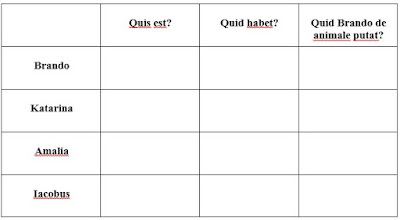
- Ping-pong/volleyball reading of 1st chapter.
- Timed write of the 1st chapter.

Day 6 and following
Bob wrote up a cultural reading on Roman pets. I will share this and how we taught it in a later post.
Observations
- I was absolutely floored by how smoothly the reading went and how students kept saying "how easy it was to read." I credit this to pre-teaching the majority of the vocabulary and to Carol Gaab's brilliant crafting of the story with limited vocabulary and TONS of meaningful and compelling repetitions!
- After the reading on Day 3, 90% of the students who answered the survey said that they were able to understand at least half of it (with the majority stating that they understood the majority of it). On Day 4, I was absolutely floored by how well they were able to answer and to take part in the post-reading discussions/activities i.e., they really did understand it!
- The cartoon was not actually part of the original lesson plan. I had planned to jump into the reading on Day 2, but Bob ended up getting sick on that day, so we decided to create a preview cartoon for Day 2. This actually worked in favor for our students, as it eased them into the reading and served as an embedded reading for them.
- You may want to do a read-dating or airplane reading for the ping-pong/volleyball reading, because I gave students 10-minutes to read this in partners, and although students could read the chapter, they complained that 10 minutes seemed like a long time. Adding movement of some kind may add some novelty to the activity and make student unaware of the time.
Tuesday, November 1, 2016
The Importance of Pre-Teaching Vocabulary
Bob Patrick and I have begun teaching Brando Brown Canem Vult in our Latin 1 classes at Parkview. As I have never taught a CI novella before, this is all new to me. I am definitely learning a lot in the process!
In my Latin CI journey over the past few years, one of the biggest concepts which I have learned is the difference between reading and translating/decoding. When I was learning Latin in high school and in my college/graduate level Latin courses, "reading" consisted solely of decoding large portions of classical texts, which were written at a VERY high level of Latin. In order for me to translate the text, it was necessary for me to have a Latin dictionary, a grammar primer of some kind, and an English translation of the text in order for me to check if I had gotten it correct. To me, that was reading, when in reality it was very tedious decoding. I was not doing any reading at all, because the language structures and vocabulary were beyond my knowledge, so I had to rely 100% on a dictionary, grammar books, and an actual translation to establish meaning. Due to my experiences at Rusticatio and in teaching CI, I have learned that reading and translating are two completely different skills and that it is possible to read Latin as Latin! I had never experienced that before in my college and graduate classes, as we focused purely on translation/decoding.
In order to ensure that something is readable, one must be familiar with 90% of the words in the text. When a large portion of words are unknown to the reader, frustration ensues, and one's affective filter rises. Readers will give up if a reading is incomprehensible. So many times when we see students give up on a reading, we blame the student and label him/her as "lazy" - have we ever thought that this is actually a normal reaction to a text which he/she finds incomprehensible?
Because I wanted students to start reading Brando Brown Canem Vult this semester, it required me to be 100% deliberate in what vocabulary I taught leading up to it. At the very beginning of the semester, using an online word count tool, I entered in the first chapter of BBCV (a downloadable PDF of the first chapter exists on the TPRS Publishing website) in order to determine word frequency (at this time, a Latin teacher's edition does not exist, but I am assuming that the TE will have something like this when it comes out). This is what I found:

This list became my guide as to what vocabulary words I was going to preteach for the semester so that students could read the first chapter. For 11 weeks, my goal was for students to acquire at least 50 of the words (a number of the words on the list are cognates or only appear once in the chapter so those words could be glossed) through various stories and activities so that by the 12th week, the first chapter would be quite comprehensible for students. During these 12 weeks, Bob and I also taught more words than just these, as we also did a cultural reading on Roman houses vs. insulae, and we did a reading on the creation myth. My goal, however, was always to begin Brando Brown Canem Vult by mid-end of October.
When it came time to introduce the first chapter, I was quite nervous if students would find the reading difficult. Just because I had pretaught most of the vocabulary did not necessarily mean that it would transfer to student ease in reading the novella. For the first day of reading, I simply handed the books to students and had them follow along as I read the first chapter aloud to them. When I was done, I asked them what they thought. The majority of students said, "That was actually pretty easy." I took that with a grain of salt, though, because in my mind I kept thinking, "Just because students say that it was easy does not mean that they totally understood what they read." On the following day, I did some post-reading activities (of which one was a Kahoot game completely in Latin based on the 1st chapter), and I was blown away by how students responded in the target language. Yes, the majority of students truly understood what they had read! The fact that they knew most of the vocabulary words in the first chapter had to mean something in terms of their comprehension! A few students even commented to me, "Now I understand why you had use learn words like molestus and ingeniosus."
Next post: the Brando Brown Canem Vult 1st Chapter Lesson Plan
Thursday, October 27, 2016
Using Optical Illusions to Teach Numbers
My friend Justin Slocum Bailey has a TON of CI resources posted on his Indwelling Language website. Just recently, I have been using many of them in my Latin 1 classes, and quite honestly, I do not know why I waited so long to use them.
For the past few weeks, I have been using Justin's idea of using pictures to generate language. He has a GREAT post here with directions and links to picture websites. I have been using many of these pictures in Latin 1 as warmups in order to give students more input of the language and for students to respond with "output."
Lately, I have been using optical illusion pictures where students have to find "how many of X" are in the picture. This is a GREAT way to get in repetitions of cardinal and ordinal numbers in a MEANINGFUL context. Although I could simply teach students to count to X in Latin (boring), when using a context to teach numbers, it is a lot more personal (and we know the value of personalization in a CI classroom!).
Recently, I used the following picture (note - this picture required me to know the names of animals in Latin):

Observations
For the past few weeks, I have been using Justin's idea of using pictures to generate language. He has a GREAT post here with directions and links to picture websites. I have been using many of these pictures in Latin 1 as warmups in order to give students more input of the language and for students to respond with "output."
Lately, I have been using optical illusion pictures where students have to find "how many of X" are in the picture. This is a GREAT way to get in repetitions of cardinal and ordinal numbers in a MEANINGFUL context. Although I could simply teach students to count to X in Latin (boring), when using a context to teach numbers, it is a lot more personal (and we know the value of personalization in a CI classroom!).
Recently, I used the following picture (note - this picture required me to know the names of animals in Latin):

I simply opened by asking my Latin 1 classes "Quot animalia in pictura sunt?" (You can also ask "Quot animalia in pictura videtis?" to change the language structures). Students will most likely call out numbers in English - I am fine with this, because I will then recast their answers in Latin. If you do this enough, students will start to call out their answers in the target language. Once I figured that students had reached their answers, then I began to explain the picture in Latin and to point out the various animals. Example:
primum animal in pictura est serpens (point to the serpent). Unum animal! secundum animal in pictura est procyon (racoon). Unum animal (point to serpent), duo animalia (point to racoon)! primum animal est serpens, secundum animal est procyon, tertium animal in pictura est testudo (point to turtle). Unum (point to serpent), duo (point to racoon), tria animalia (point to turtle)!...
In using these types of pictures, I was able to get in LOTS of repetitions of cardinal and ordinal numbers simultaneously in a meaningful context. Do I expect them to remember the cardinal and ordinal numbers in Latin immediately after this and to be able to recite them? Not really (although my high-flying students may be able to), but that was never my goal per se - my goal was to deliver understandable messages in the language.
Observations
- Optical illusions work, because students will be automatically engaged in them. These types of pictures serve as a common activity in which the entire class can be involved.
- In many ways with optical illusions, there is no "true" right answer, because what one person sees is not always seen by another and may never be seen by another, even after it is pointed out. Just because I do not see something which a student sees, it does not mean that it is not "there.
- "Depending on the picture, one can introduce a number of different vocabulary items in the target langage, such as body parts, animals, shapes, etc.
Tuesday, October 18, 2016
"Short and Sweet" Follow-up Lesson Plan
The following is the Latin lesson plan which I created based on the Short and Sweet Movie Talk from the previous blog posting. Once again, I thank Lauren Watson for sharing some of her ideas with me! I have also included English versions so that you can adapt it for your own target language.
Latin target words
puella, puer, magnus, parvus, valde, inquit, eheu, quod, alter
English target words
girl, boy, big, small, very much, says, oh dear, because, the other
Day 1
Short and Sweet Movie Talk to introduce target words
Day 2
1) Introduce short reading based on Short and Sweet Movie Talk, using circling and PQAs (Latin story to project/ English version)
2) Choral reading to establish meaning
3) Play Stultus with the reading
4) Class blind retell of story in target language based on screenshots (pictures to project)
Day 3
1) Cloze sentence activity (ppt to project)
2) Parallel story reading (Latin story / English version)
3) Sentence Flyswatter (pictures to project)
Day 4
Find the Sentence (handout)
Timed Write
Day 5
Ping-pong reading of embedded version of story (Latin version #2 of story/ English version)
Tuesday, October 11, 2016
Movie Talk Script - Short and Sweet
Yesterday, Bob Patrick, Lauren Watson, and I were invited to give a 1/2 day CI in-service at a neighboring county about an hour away. Bob, Lauren, and I have given numerous CI in-services in our own district, so we felt very honored to have the chance to visit another district to share our CI knowledge (in fact, a teacher in that district asked us to come, because she found our names through Martina Bex's database of CI teachers - thanks, Martina!).
I always love giving presentations with Bob and Lauren, because I get the chance to learn so much from them during their demos. Lauren teaches French, so learning some French via CI is ALWAYS helpful, because I get to experience her demo like a student. Yesterday, Lauren's demo was a Movie Talk in French, and I really liked what she did...so much that as a result, I actually typed it up in Latin and did it today with my own Latin 1 classes. It is with Lauren's permission that I share her Movie Talk with you here.
The Movie Talk is called Short and Sweet, and Lauren used it to introduce words such as boy, girl, loves, big, small, not, sad, says. It is actually very short, but you can do SO much with this. I was actually surprised at how engaged my students were in watching it.
English script
Latin script
Observations
- When Lauren demonstrated this, she only showed it up to 1:50 the first time, because there is a plot twist which occurs. It is best when the Movie Talk is shown completely through a second time uninterrupted with the ending.
- Lauren also showed it without sound the first time. She says that she likes to do this in order to keep students focused. Normally I will do a Movie Talk with the sound, but for this one, I would do the first run-through without sound, because I found the background music to be very annoying - it sounds like something from the Kahoot soundtrack.
- My students absolutely were totally taken in by the plot twist at the end (as was I when I saw it the first time).
Thanks, Lauren - my students really enjoyed it.
Subscribe to:
Posts (Atom)