Showing posts with label purposeful. Show all posts

Wednesday, January 7, 2026

Revisiting Dictations - Embedding Purposeful Communication

I am not a fan of dictations. I find them boring, and while I understand how they can aid in both the acquisition of language and the creation of orthographic mapping in students' minds, my students really do not like them. One student told me, "This is like taking notes!"

I am currently reading Common Ground: Second Language Acquisition Theory Goes to the Classroom by Maris Hawkins and Florencia Henshaw. In the first chapter, Hawkins and Henshaw discuss how to transform traditional activities into ones which reflect a communicative aspect; among these, they discuss a dictation. This can be found on pages 17-18 (according to my Kindle, so the pages may be different in a hard copy).

I tried out this modified dictation today in my Latin 1 classes, and I really like how it went. I did make some changes to how they present it in their book, but the spirit is still the same. I TAKE NO CREDIT FOR THE FOLLOWING - THIS IS ALL HAWKINS AND HENSHAW!

As is the example in the book, the focus of my dictation was on introducing the phrase "I like" (in Latin, mihi placet - literally "it pleases me").

  1. I looked online to find the top six ranked activities which American teenagers like to do. I used Gemini AI to help find the ranked activities (so take with a grain of salt the accuracy), but according to a 2025 Pew Report as found by AI, the top six activities in order are:
    1. watching digital content (Disney +, Hulu, Netflix, etc)
    2. being on social media (Tik Tok, Instagram, Snapchat, Discord, etc)
    3. listening to music
    4. playing video games
    5. sleeping
    6. playing sports
  2. I then scrambled the order and wrote them up as dictation sentences in Latin with the phrase "mihi placet....". There were a number of words and phrases for which I had to establish meaning in English and Latin: social media, video games, to watch digital content. 
  3. From here, I treated this as a regular dictation activity.
  4. Once the dictation activity was done, I then asked students to rank these activities from 1-6 according to THEIR preference.
  5. Then I asked them to rank these activities according to how they thought AMERICAN TEENAGERS had answered.
  6. I then projected a slide, revealing the Pew Report answers in Latin one at a time, starting with #6. 
Observations
  1. While it still was a traditional dictation in a way, I loved the purposeful communication aspect of it at the end. Students were learning about themselves and their interests compared to how they "ranked" on a national poll.
  2. I felt that having students rank their interests at the end according to their preferences and then predict what American teenagers said gave a sense of anticipation when I revealed the rankings - it felt like a game show! 
  3. As a teacher, I definitely felt more engaged in the activity, since I knew where the dictation was heading. Most times, I end up zoning out... 
  4. In Latin, much like Spanish, the phrase "I like" is usually followed by an infinitive. I had not yet introduced the infinitive form, but because I had sheltered vocabulary last semester, students already knew the verb forms for hear/listen to, play, and sleep. So while I still established meaning for the infinitive forms during the dictation, I was able to do lots of quick pop-up grammar during it by saying, "You already know that ludit means 'plays' - ludere means 'to play' - the -re is where I am getting the 'to __________." Using the phrase "I like" seems like a natural way to introduce the infinitive of known verbs.
I would love to do more purposefully communicative dictations in the future - what are some suggestions which you all have?

Thank you, Maris Hawkins and Florencia Henshaw!

Friday, September 12, 2025

Rotating Desks

If you have not gotten a copy of Eric Richards’ book “Grafted Writing,” please do so. In it, he details numerous ways to get students writing in a very guided manner - this is great for beginning writers! One of his ideas is called “Rotating Desks.” At the 2023 CI Summit in Savannah where Eric demonstrated numerous strategies from his book, I took part in this activity, and it is a lot of fun!

Directions (his and my adaptation)

  1. Choose a text (or write your own), and use it to create a projectable slide presentation.
  2. Remove an element from each slide, such as vocabulary or grammar, to create “blanks.” 
  3. Label the blanks with the missing element (“noun,” etc.) so the students will know what they are looking for. Students will be adding their own details based on the "blank" description.
  4. After you have created the presentation, you can do the following activity in class. First, have students start with a whiteboard (write their names on their boards) at the top but small OR use a piece of paper.
  5. Then project slide one on the board. Students will write down the entire text from the slide and insert the missing elements/new details. Tell them to write small because there are a number of sentences.
  6. Students rotate to the next desk, but the paper/whiteboard STAYS. Teacher projects slide two. Students read the previous sentence and then add the content of slide two to the paper/whiteboard.
  7. Repeat until slides are done.
  8. Students return to their desks and read them.
  9. MY ADAPTATION - since I am in a trailer this year and am deskless, students used whiteboards, and the whiteboards "rotated" for each slide.

Here is what I recently did with my Latin 1’s:

  1. Puer est in (name of place/ store/ city).
  2. Is est (size) puer.
  3. Ei nomen est (name).
  4. Is (name of female cartoon character/ female singer / female celebrity) videt.
  5. (name from #4) est tristis, et habet (name of object / thing/ food).
  6. Puer (different object / food/ thing) fert.
  7. (name from #4) non puerum amat, sed (name of male cartoon character / male singer / male celebrity).   
Student example (in English):
1) A boy is in Buc-ees.
2) He is a big boy.
3) His name is Oscar.
4) He sees GloRilla.
5) GloRilla is sad and has a CrockPot.
6) The boy brings Takis.
7) GloRilla does not love the boy but Cookie Monster.

Observations
  1. I love this activity on SO MANY levels! I do not know where to begin. This activity definitely has a Mad-Libs feel to it. 
  2. First, I love the guided output aspect of it. Although I am telling students what to write (and those messages are hopefully 100% comprehensible for them!), there still is a degree of choice for them of what details to add.
  3. This is a GREAT example of purposeful communication, because students are playing with the language in adding their own details.
  4. This is a written form of TPRS/Storyasking! Instead of asking students to come up with details orally, they write them down instead.
  5. Because I am asking them to write down known vocabulary and phrases, students are getting repetitions of understandable language in a context which adds to/modifies/enlarges their brain's mental representation of Latin.
  6. When students get a new whiteboard, they must read what has already been written before they can move onto writing the new sentence. What they read should already be 100% comprehensible by this point, because A) the sentence frames are recycling known phrases and words from class but also B) students have already interacted with those sentences by writing them down on the whiteboard.
  7. I loved hearing students laugh when they got back their original whiteboard and read what students had added!

Consider adding this to your toolbox of writing activities!

Wednesday, June 18, 2025

Left/Right PQAs - Purposeful Communication

This past weekend, I attended/presented at Comprehensible Iowa in Des Moines. This was my second time attending/presenting at this local conference, and again, it did not disappoint at all! I truly love Comprehensible Iowa (you can read my post about it from last year), because the organizers put on a such a great conference - lots of very good presenters, a very communal and welcoming Midwestern atmosphere, a great social gathering following the Friday workshops, and plenty of food and snacks!

On the first day, I co-presented a 3-hour adult German language lab with Eric Richards - since Eric is a German teacher, he did most of the heavy lifting in leading it, while I led the debriefs. Because of this, I was able to participate in the language lab; I absolutely LOVE being a participant in language labs where I do not know the language, because then I can experience learning a language like one of my own students. Years ago, being in Linda Li's Mandarin Fluency Fast class was such a turning point for me in my CI/ADI journey, and Eric is a master at implementing CI/ADI as a German teacher! Every time I sit on a German session led by Eric, I learn so much from him.

One activity which Eric facilitated during this language lab was Left/Right. Eric wrote the words "links (left)" and "recht (right)" on the appropriate sides of the board and then projected a question slide similar to this one:

Our job was then to move to the proper side of the board which best reflected our answer. Although a very simple activity, Eric did SO much with this:
  1. After we had moved to our sides, Eric counted us in German and then said in German, "X have brothers." Then depending on the numbers, he said, "More do have (not) a brother. Most have (not) a brother."
  2. He then in German asked some of those who had brothers "Is your brother older or younger? Do you have one brother? Is your brother friendly? What is your brother's name?"
  3. From then, Eric projected a new slide asking us a new question, and as previously done, he repeated the same pattern of questions.
I absolutely LOVED this activity which Eric did for so many reasons:
  1. Even though the activity was in German, Eric had scaffolded the lesson already to such a degree that the necessary vocabulary had already been previewed and meaning established, so it was incredibly comprehensible for us.
  2. It was a wonderful example of purposeful communication in that all of us participants were able to learn about each other nonverbally based on what side of the board we were standing and then verbally through Eric's followup questions.
  3. The movement aspect made the activity quite compelling and novel, instead of the traditional "raise your hand" kind of response.
  4. This activity was done throughout the 3 hours so although each time it involved a new set of questions, we became very familiar with it.
  5. Eric changed up the slides so that not every one was necessarily a question, e.g., "I swim __________" (left - good, right - bad); "I have a _________" (left - iphone, right - Android phone); "I need more ________" (left - luck, right - patience). I not only loved how our responses were not always to a question but that Eric snuck in the first person singular forms. However, since the focus for us participants was not on grammar per se but rather on the activity, I do not think I even noticed that the form of the verb had changed. 
  6. Although it started out as a group PQA, by Eric then asking individuals about their answers, it turned into an individual PQA. Eric did a master job at "keeping the balloon in the air" (I think this is a Ben Slavic phrase?) with questions until he felt that it was time to move on.
This is just one of the many CI/ADI strategies which I learned this past weekend at CI Iowa, and I will be blogging about them. I hope that you will consider attending CI Iowa in summer 2026 - I am already planning to attend, so I hope to see you there!

P.S. If you are attending CI Summit next month, Eric will be leading the German language study class and will be doing this activity as part of the lab. Consider taking the German class, because you are in for a treat! 

Wednesday, January 15, 2025

Purposeful Communication through Pets

I have been back in school for a 1.5 weeks now (even throw in a snow day here in Atlanta!). Since it is the beginning of a new semester, with my Latin 1 students, I want to focus this semester on readings involving animals. I also really wanted to get back into being purposefully communicative with them (I feel like I began to slack off last semester). 

Remember that in purposeful communication, our goals are to learn about ourselves, each other, and the world around us. These goals are what guided this multi-day activity.

Anne Marie Chase (Senora Chase) has a great lesson about Picture Talks/PQAs involving students and their pets, along with a Google Slide in different languages which you can download. I implemented this and then extended it into purposeful communication.

Day 1

  • Assignment - students filled out the Latin Google Slide as an assignment on Google Classroom. Each student was assigned just one slide to fill out, instead of a class slide which everyone filled out.
Days 2, 3, and 4
  • I picked slides to project and did a few Picture Talks with students about their pet(s). The slide has all of the language/established meaning there on it. I only spent out 10 minutes/day on this.
  • A way to extend the activity and to bring up past knowledge is to ask students about earlier slides from days past: "Who has a cat named Mr. Whiskers?" "Who wants a small lion?" etc.
Day 4 
  • This is something which I learned from Bill Van Patten and then saw demonstrated again at this past ACTFL. After the last round of Picture Talks on Day 4, I then projected the following slide (CFA is the Latin abbreviation for the United States of America - Civitates Foederatae Americae):
  • Using the chart, I began asking in Latin: "In America, what animals do most Americans have? In America, what animals do fewest Americans have?" From there, I began asking individual students in Latin, "Do you have a fish? Do you have a reptile?” to see if their pet reflected the chart.
  • I then asked students to raise their hands when asked in Latin “Who has a dog?” “Who has a cat?” Draw attention that the class most likely reflects America in respect to pets: “Most students also have a dog. Fewest students have a bird or reptile." This took about 10 minutes.
Observations
  1. Students actually want to talk about their pets, so a personalized Picture Talk is a great way for students to learn about each other.
  2. It is a very easy, comprehensible activity to do with level 1 students.
  3. If possible, consider creating a slide of your own and talking about your pet(s) you have or want. I do not have a pet but I am 100% a dog guy! Let students learn about you!
  4. Extending this communication to learning about the world around them and then comparing it to students' own lives is not that difficult and is rather a natural extension.
Give this a try - thanks, Anne Marie!

Tuesday, November 12, 2024

Purposeful Communication with Movement: A Collaborative Blog Post with Eric Richards

This is a continuation in my series on purposeful communication.

This is my first of what I hope are many collaborative posts with Eric Richards. I first met Eric at the 2023 CI Summit in Savannah. Both of us were assigned to serve as team members/trainers for the same cohort (woohoo - go Cohort 2 with Gary DiBianca and Andrea Schweitzer!). Although I had never formally met Eric before, I did know of his name (and that he was an ACTFL Teacher of the Year Finalist for 2021!) and had seen him present digitally at the 2023 Voces Digital Spring Conference - I was very impressed with both his presentation and very comfortable online demeanor and delivery. When Eric and I were on the same team, we hit it off, and since he teaches German and I am a Latin teacher, we were the ones tasked with doing the cohort L2 demonstrations since the majority of teachers in the cohort were Spanish and French teachers. I always learn so much about CI/ADI pedagogy from taking part in/observing L2 demos where I do not know that language, so I was able to see Eric daily demo PQAs in German (and a later presentation on writing) - all of Eric's demos/presentations were so good that I have now "Latinized" his first week PQA lessons for my own classes!

Anyhow, Eric recently wrote up a post on his own blog about his reflections on my presentation on purposeful communication at Comprehensible Iowa this past summer (read his post - it is a good one!). He had also emailed me about how he implemented a purposeful communicative activity involving movement with his classes similar to my pizza topping bellringer, which in turn motivated me to facilitate one based on his list of PQA questions. 

As a result, I asked Eric to write up his experience for this blog, and in turn, I would then add my own activity inspired by this. I hope that you will enjoy and learn from our posts here!

Eric Richards - Four Squares for more Purposeful Communication 

This school year, I’ve been considering the role of communication in the classroom, how I deliver content, and how I engage with my students. As I gave thought to this, I realized that I need to adjust the way I communicate and how I approach some activities in class. I need to be more purposeful in my communication and engagement with my students.

That is, I need to communicate (more) in a way that allows me and my students to:

  • learn about each other and ourselves (build our relationships through language)

  • learn about the world around us (learning information)

  • entertain/create with language in fun, engaging ways (language play)

But why?

According to Bill Van Patten, “Language use without purpose is not communication.” That is, we may be using the language, but without purpose, communication may not be happening – and I definitely want communication to happen in my classroom!

(Let’s fast forward a bit.)

As I adjusted lesson plans for this school year to better meet my goals, I started thinking about if there was a way to get a little extra “bang for your buck” with the activities. After a bit of reflection, it hit me – incorporate more movement with the activities!


But, before we move on, let’s quickly review a few reasons why movement in the classroom is beneficial (for both students and teachers):

  • Increased Focus and Attention: Short movement breaks or incorporating physical activity helps students refresh their minds, improving focus and concentration.

  • Enhanced Learning and Memory: Movement activates multiple areas of the brain, which enhances learning, memory retention, and cognitive function. 

  • Improved Behavior and Reduced Disruptions: Regular movement opportunities help reduce restlessness and behavioral issues. (Plus, it supports kinesthetic learning.)

  • Increased Engagement and Enjoyment: Incorporating movement makes learning more engaging, which can help increase student interest.

So, with that in mind, I began incorporating movement into my lessons. Note: I kept it simple! I was not about to reinvent the wheel, and I sure was not going to throw all my lessons out and start over! As they say, “Ain’t nobody got time for that!”


Here is what I did: 


I made a quadrant in the middle of the room. (I have a deskless classroom, but you can simply label 4 corners/areas in your classroom to substitute the quadrant, if you don’t have space.)

That’s it!

Then, I started incorporating movement into activities that helped me achieve more purposeful communication. Note: I sometimes incorporate movement activities at the beginning of class and sometimes at the middle or end. It just depends.

Also, did I mention that I kept it simple?

Here are some examples of the activities:

I use this one the second day of German I. We are focusing on (very) good / (very) bad.

  • This is another activity from the first week of German I. Once they are comfortable the structure, e.g., “Can you play ____?”, you can incorporate a new vocabulary word (using both text and pictures):
  • Again, don’t reinvent the wheel! Use what you have and simply build on it! In this example, I simply added “good (well)” to an already familiar structure. It allows you to build in new vocabulary while also changing the “feel” of the question.

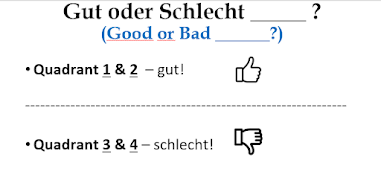
Here is another example of how you can level an activity. In this pizza topping activity, which I stole from Keith Toda, I had them sort the toppings on their note sheets (paper) according to how each student liked – or disliked – a topping. Then, they got up and moved accordingly (in the quadrant - good or bad -) as we had a discussion. Again, I repeat, don’t reinvent the wheel! Take what you have and level it up and down where you can!


As this was in German II, I led the discussion and questions at a more appropriate level. Obviously, they know “good” and “bad”, so I incorporated vocabulary like "majority" and "minority", e.g. After they moved, I would say, "Oh. The majority of the class likes pepperoni on their pizza." This scenario also gives you the chance to level up and introduce a structure like, “Would you eat ….”, e.g., “Would you eat a pizza with broccoli on it?” Or, introduce a relative clause like, "Would you eat a pizza that had broccoli on it?"


Not only did this provide a chance for oral input - because they had to listen to which topping I said and what questions I asked – it also gave the chance for students to respond and answer ‘why’, e.g., “I don’t like onions. They taste bad.”
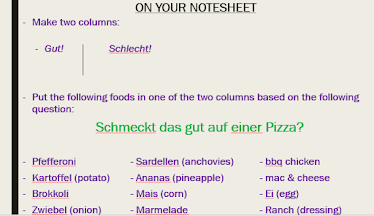
A screenshot of a note sheet

Description automatically generated
A white paper with black text and symbols

Description automatically generated

Observations

  1. This is a simple, effective, and well-received activity. The students enjoy it, and they appreciate the opportunity to get up and move around. In fact, when we do different activities that don’t involve movement, they ask if they can get up and do something similar. (And when I say ‘no’, I see plenty of frowns.)

  2. Also, using a quadrant for movement is simple to incorporate into existing activities; in other words, it is low prep! It can easily be used to implement question and answer responses. Plus, you can adjust the level of the questions to fit the appropriate level of target language. That means, you can use the same activity for different levels! 

  3. In addition, incorporating four squares and movement into your lesson gives students the chance to learn about others and use the language in an enjoyable, engaging way – both non-verbally and verbally. In other words, they are (literally) moving with purposeful communication.

Lastly, I will give you a couple of things to consider. Students will sometimes move to quadrants where their friends are, even if it isn’t their true answer. This can lead to side chatter (not in the target language) between peers and cause distractions. It also can bring about a lack of attention to the oral input that you are giving (in the target language). To help with this, you need to model the activity. You need to work with students and set expectations from the beginning – and stick to them! Don’t forget to explain to them that you are trying to make this enjoyable and effective for everyone!


Tip: It is okay to make them sit back down and get back up and do the same activity again until they meet expectations. 


Also, some students can be hesitant to get up and move. They are sometimes tired, “not in the mood”, etc. In this case, you’ll need to decide if you want to encourage them to participate or let them sit this one out. You just need to find the balance that works for you (while also not abandoning your expectations!)


I hope this helps get things “moving” in the classroom! Please let us know how it goes in the comments below!


Keith Toda - Moving Purposefully with Four Corners PQAs


When Eric had contacted me about how he was using movement with PQAs, especially with the pizza topping bellringer, I had never thought about connecting PQAs and purposeful communication with movement. However, I thought that this was a great idea! My PQAs were definitely getting rather stale (both teacher and student were hitting a wall when it came to academic motivation), so I decided to try out asking PQAs as a Four Corners activity.


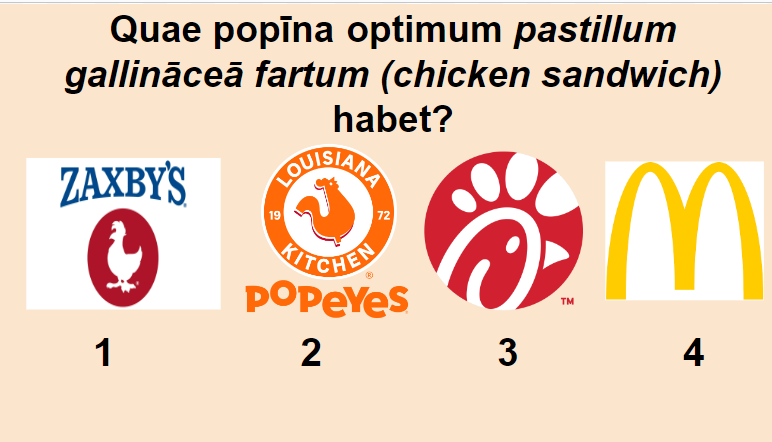
At the time in my Latin 2 classes, I had just given a purposefully communucative, cultural lesson in Latin about popinas (restaurants), so the next day, I decided to ask students a series of questions related to fast food restaurants in a "Four Corners" kind of way (where student would respond by moving to that corner of the room which corresponded to their answer). Each corner of the room was numbered accordingly, and I projected the first slide. 

After students moved to their corners, I would then ask invidual students opinion questions:  "tua sententia, estne Carlos rectus? Taco Bellne optimum cibum Mexicanum habet?" After asking this a few times about different students, I then revealed my pick: "mea sententia, Chipotle optimum cibum Mexicanum habet." Then I proceeded to the next question and repeated the process.

Observations

  1. I love these kinds of PQAs, because EVERY student has an opinion about fast food! I loved it that students would "argue" with each other and with me about which fast food restaurants had the best food!

  2. Students really wanted to hear my opinion on which fast food restaurant had the best X - maybe they wanted to learn about me, or maybe they wanted adult validation for their answers!

  3. I loved it when a particular corner would just have 1-2 students - I am glad that they felt safe enough to "voice" their opinion even if "unpopular." They were usually the ones whom I would ask the follow up opinion questions.

  4. Because this involved every student moving, students got to see others' responses (which is different from a traditional PQA where I may ask individual students or ask for a show of hands). 

  5. This activity definitely shows that purposeful communication does not always have to be verbal - we can still learn about ourselves and each other non-verbally. 

  6. As a teacher, I learned a lot about my students, even if it was just about their favorite fast food restaurants!

  7. This activity lasted about 10 minutes.

***************************************************************************************************************Anyhow, Eric and I would love to hear your experiences in the comment section - hope you can use these in your classrooms!

Wednesday, June 21, 2023

Embedding a Textbook Dialogue - Example

When we engage in communication with our students, the goal should be that it be purposeful in nature. According to Bill Van Patten, "Communication is the interpretation, expression, and/or negotiation of meaning for a purpose, in a given context." How do textbook dialogues align with this definition of communication?

By nature, textbook dialogues are artificial, because no true purposeful communication is occurring. Yes, there appears to be an exchange of dialogue, but most likely, when we have students recite textbook dialogues, that is all it is: reciting. It is memorization and contrived communication. 

In addition, many textbook dialogues are set in environments outside of the classroom, which contributes to its artificiality. To quote something which I had written in an earlier post about purposeful communication:

[Purposeful] communication needs to occur in a realistic context and setting. Therefore, since we as teachers are communicating in a classroom, our communication needs to reflect what would occur in a classroom. The traditional textbook dialogues/role plays of "a trip to the doctor's office," "ordering a train ticket," and "maneuvering through the airport" are not truly communicative, because they are artificially set and delivered in a classroom context (and not in a doctor's office, train station, airport). If you wish to do those dialogues, then students need to be in those actual environments for these activities to have a true setting.

By no means does this mean that textbook dialogues are bad per se, but if you wish to align them with purposeful communication, then do the following: embed them into a reading, such as a story, diary entry, letter, etc. In doing so, now the textbook dialogues are in the realistic context of a classroom and can therefore be discussed in a classroom setting.

Below is an example of a reading which I created back in 2015 (before I even knew about purposeful communication) - it is translated from Latin into English. It incorporated greetings into a reading, and it was about two students of mine named Ian and Mustafa. I know that there is a similar Spanish version of this story out there, since Meredith White took my story and adapted it into Spanish: 

Ian sees a girl. The girl is beautiful. Ian loves the girl. Ian says, “O girl, hello. How are you? My name is Ian. What is your name?” The girl says, “Hello, Ian. I am fine. My name is Go Away! Goodbye!” Ian is sad.

Mustafa says, “What is her name?” Ian responds, “Her name is Go Away!”

Ian sees another girl. The girl is beautiful. Ian loves the girl. Ian says, “O girl, hello, my name is Ian.  What is your name?” The girl says, “Hello, Ian. I am very well.  My name is You are Annoying. Goodbye!” Ian is sad.

Mustafa says, "What is her name?” Ian responds, “Her name is You Are Annoying!”

Since these greetings were set in a reading, as a class we could discuss and review them in a classroom setting much beyond the traditional way of simply saying hello to students and asking what their names are and how they are doing.

Consider embedding textbook dialogues into readings to create purposeful communication!